Skip to content

Medical records retrieved, chased, paid and filed in your CMS

Tavrn requests treatment records and itemized bills from every provider on the matter, follows up by fax, portal and phone until they arrive, pays the provider invoices under your approval limit and delivers everything into Litify, SmartAdvocate, Clio, Smokeball or Filevine. Built for personal injury, mass tort, medical malpractice and workers’ comp firms.
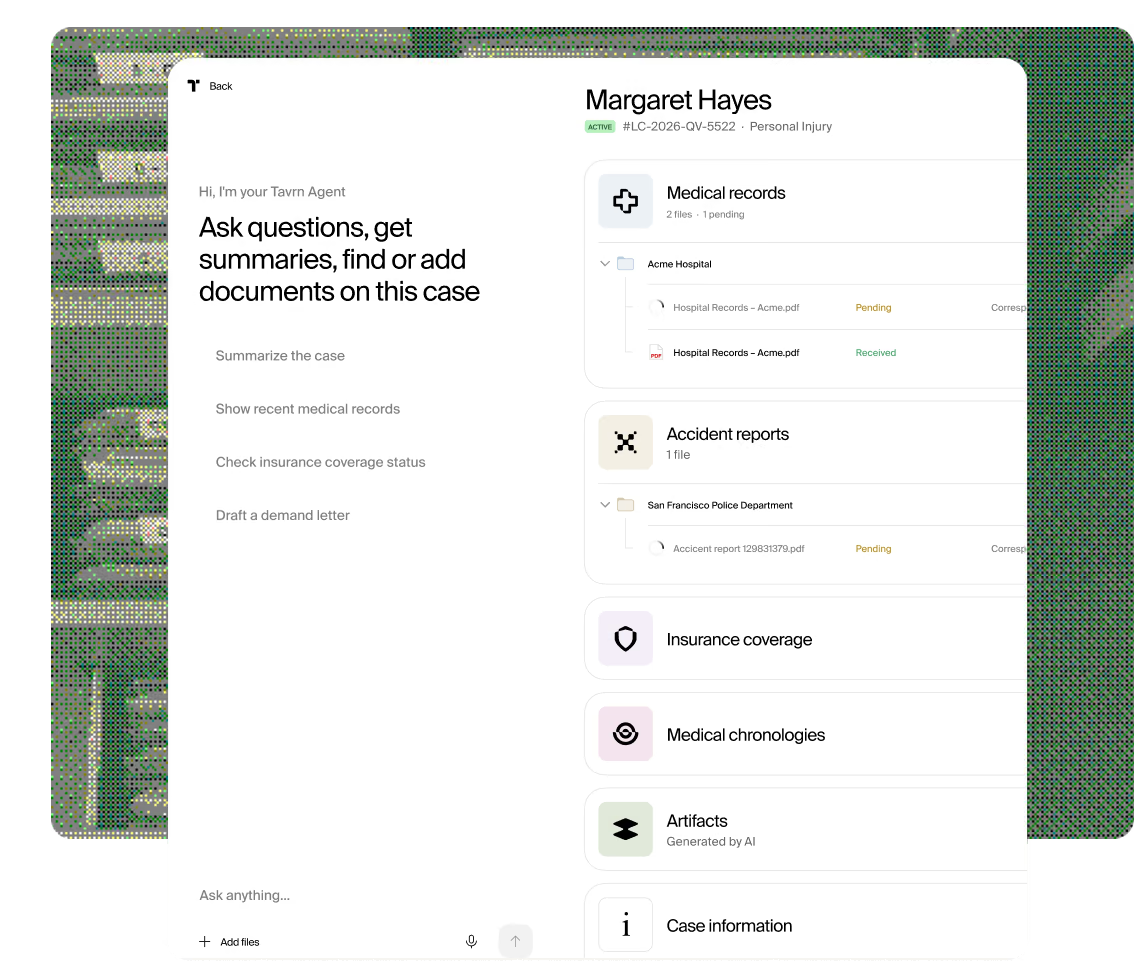
Tavrn case view: the Tavrn Agent panel beside a case's medical records, accident reports and insurance coverage

In numbers

Retrieval at a scale one firm never reaches

56,000+

Completed record requests

2–3 weeks

Most records back, request to delivery

500+

Organizations retrieving with Tavrn

Practice areas

Built for every plaintiff practice

Personal injury

Treatment records and itemized bills from every provider the client saw — ER, imaging, specialists, therapy — are the demand. Nothing goes to the adjuster until the last one is in.

  • Demand-ready records

    Treatment and billing records from every provider, with live status on each.

  • Prior treatment

    Pre-suit and litigation records, including prior treatment, on the same authorization.

  • Follow-up every 48 hours

    Demand deadlines don’t wait on a fax queue.

  • Filed to the matter

    Records and bills land in Litify, SmartAdvocate, Clio or Smokeball, with fees posted as case costs where supported.

The problem

Every demand waits on the slowest provider

  1. 01Today

    Three weeks pass and nobody knows where the request stands

    A paralegal sends the authorization, then calls the records department whenever there is a gap in the day. Hospital portals, fax confirmations, wrong fax numbers and a provider that wants its invoice paid before it will release a page.

    37%

    of a patient’s record sits outside every network and portal combined

  2. 02The cost

    Cases sit, clients call, and the fees land on the wrong matter

    Nothing goes to the adjuster until the last chart and itemized bill are in. Meanwhile provider invoices, clearinghouse fees and re-requests pile up with nothing tying them back to the case.

  3. 03With Tavrn

    Every provider chased, every contact logged, every fee on the matter

    Tavrn sends the request, confirms receipt, follows up by fax, portal and phone until the records and bills arrive, pays the provider under your approval limit and files everything to the matter in your case management system.

    100%

    of providers on a request followed up until they produce or confirm no records

How it works

From authorization to records in the matter

  1. A new request starts in the Tavrn platform, from Clio, SharePoint, Smokeball, Litify, SmartAdvocate, Dropbox, or from the API.
    01

    Request

    Start a request from the matter in Litify, SmartAdvocate, Clio, Smokeball, Filevine, SharePoint, the Tavrn app or the API. Tavrn finds the right records department, attaches the client’s HIPAA authorization and sends the packet the same day.

  2. A status card with one row per provider: records received, confirming receipt with a provider-stated date, action required to approve a fee, and the next follow-up in 48 hours.
    02

    Track

    Receipt is confirmed, then every open request is followed up by fax, portal or phone until the provider produces. Each contact is logged on the request and in an exportable Outreach Activity Report.

  3. A folder of checked documents filed by provider and date of service, with record type, page count and file type for each file.
    03

    Deliver

    Records and itemized bills are checked against what was requested, the provider invoice is paid under your approval limit, and everything is filed to the matter with the fees posted as case costs.

How Tavrn speeds up your records team

Records filed straight to your CMS

Records, bills and invoice PDFs land on the matter in Litify, SmartAdvocate, Clio, Smokeball or Filevine, with no re-keying.

Follow-ups handled for you

Every open request is confirmed and chased by fax, portal or phone until the provider produces.

Every delivery checked

Each delivery is checked against the request, and missing pages go back to the provider automatically.
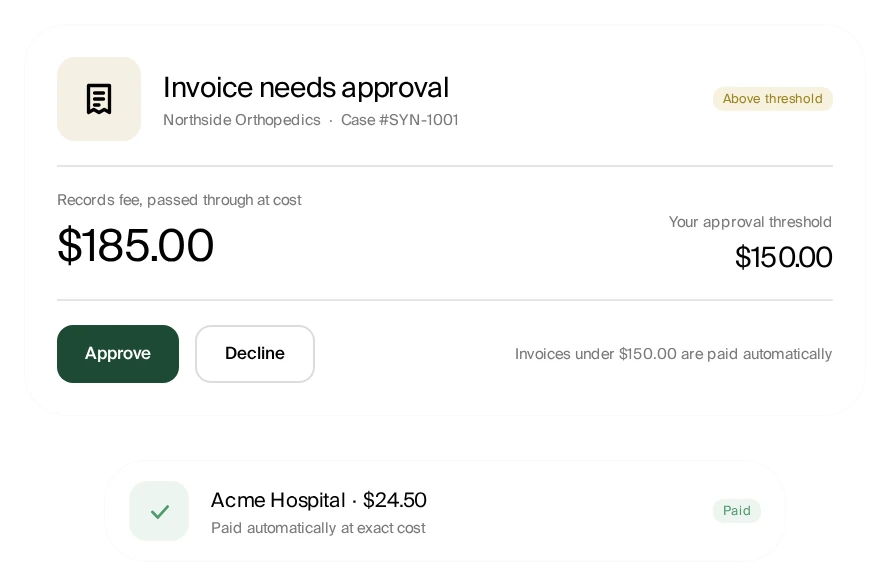
Tavrn invoice approval: a records fee above your approval threshold waiting for approve or decline, and a smaller fee paid automatically at cost

Provider invoices paid for you

Fees are paid at exact cost under the approval threshold you set, then posted to the matter as case costs.

Features

Everything a case needs.

Feature category

Reach

Complete

Every network and portal, plus the long tail

  • 425,000 providers across all 50 states + DC
  • The right custodian and authorization form
  • Fax, portal, mail, email or phone

Follow-up

Chased until it arrives

Receipt confirmed, then followed up by fax, portal and phone

  • Sent the way each provider responds
  • Receipt confirmed with records departments
  • Followed up automatically until records arrive
Learn more
  • Each request goes to the custodian the way that provider actually responds: fax, portal, mail, email or phone.
  • Receipt is confirmed with the records department, so a lost fax is found in days, not at the deadline.
  • Open requests are followed up automatically, including by phone during the provider’s business hours, until records arrive.
  • A provider that stalls is escalated to Tavrn’s retrieval team, who work the request by hand.
  • Every contact is logged with date, channel and outcome, exportable as the Outreach Activity Report.
  • A provider with nothing on file returns a no-records statement, documented on the request.

Retrieval depth

Records that hold up

The hard requests, handled as part of the request

  • Certified copies and custodian affidavits
  • Missing pages re-requested automatically
  • Trial dates move requests to the front
Learn more
  • Certified copies and custodian affidavits requested with the record, notarized where the court needs it.
  • Every delivery checked against the request. Missing pages go back to the provider; a statement of no records is documented.
  • A deposition or trial date on the case moves its requests to the front of the queue.
  • Imaging and films, pharmacy, itemized bills and full charts, each requested the way that custodian requires. Mailed discs ingested.
  • Patient-portal retrieval when the client’s own portal is the fastest route, by secure text to the client.
  • Continued care: re-request the same provider for new dates of service, with duplicates detected.
  • Clearinghouses — Datavant/Ciox, MRO, Verisma, Sharecare — handled on their own portals and payment rails.
  • Delivered searchable (OCR), with a cover page, organised by provider and date of service.

Coverage & crash reports

The whole case file, not just the chart

Insurance coverage discovery and accident reports as products, requested the same way

  • Coverage tracked across BI, PD, PIP and UM/UIM
  • Policy limits collected into one packet
  • Crash reports purchased and filed
Learn more
  • Coverage discovery per matter: BI, PD, PIP/MedPay, UM/UIM lanes, each tracked to a written answer.
  • Letters of representation and disclosure requests sent to each carrier, followed by phone.
  • Written policy limits collected into one coverage packet for the demand.
  • Accident reports located, purchased and delivered to the matter.
Provider lookup for Westside Imaging Center, verified: HIM department custodian, Westside ROI authorization form, portal then fax, accepts fax, portal, mail, email and phone
Follow-up timeline for Westside Imaging Center in Hayes v. Delmar: fax request sent Aug 4 with HIPAA authorization, receipt confirmed by phone Aug 5, portal check Aug 16, 86 pages received and checked Aug 21, no further follow-up needed
Mercy General ER records viewer: seven page thumbnails, missing pages 9–12 re-requested Aug 22, certified copy and custodian affidavit included, imaging disc ingested, priority trial date Oct 6
Coverage board for Patel v. Coastline: BI limits $100k / $300k received, PD declaration $50k, PIP/MedPay declaration $10k, UM/UIM disclosure pending, crash report CR-26-04417 purchased and filed

Speed

Fast & visible

Live status on every provider

  • Live status and dates for every provider
  • Exportable Outreach Activity Report

Provider fees

Every provider fee, visible

Provider fees paid for you, passed through at cost and tied to the matter

  • Fees paid for you at exact cost
  • Large fees wait for your approval
  • Overcharges challenged on your behalf
Learn more
  • Provider and clearinghouse fees are paid by Tavrn and passed through to the firm. Your contract sets the pass-through terms.
  • Fees above the approval limit you set wait for a yes. Everything under it is paid so the records keep moving.
  • Disputed provider invoices, such as per-page charges above the state rate, are challenged for you.
  • One consolidated Tavrn invoice, by card or ACH, with every provider fee tied to its matter.
  • No separate rush fee: a deposition or trial date on the case moves its requests to the front of the queue.

Case costs

Every fee on the ledger

Provider fees and Tavrn fees posted to the matter as native expenses

  • Expenses posted to Litify, SmartAdvocate and Clio
  • Provider and Tavrn fees kept separate
  • Invoice PDFs filed next to the records
Learn more
  • Litify Expenses, SmartAdvocate Disbursements and Clio expense entries, created from the request. No re-keying.
  • Provider fee and Tavrn fee kept separate, each with its own expense type, vendor and recoverable flag.
  • Provider invoice and Tavrn invoice PDFs filed to the matter next to the records.
  • A Case Costs page per matter: credits used, provider fees and total, ready for the settlement statement.
  • QuickBooks Online: fees posted as bills or purchases against the client, vendors kept in sync.
Request status for Hayes v. Delmar: 3 of 4 providers delivered with an average of 11 days, three providers received, Harbor Physical Therapy follow-up scheduled for Sep 2, and an exportable Outreach Activity Report with 14 contacts
Provider fee approval for Westside Imaging Center: a $184.00 imaging request is over the $150 limit, with recent fees showing Mercy General paid $42.50, St. Luke’s Medical reduced from $96.00 to $38.40, and Valley Orthopedics paid $25.00
Case costs for Hayes v. Delmar total $212.40: $117.40 in provider fees across three expenses, a $95.00 Tavrn fee, three invoice PDFs filed to the matter, and a recent Litify sync

Integrations

Use Tavrn with your existing systems

Works with the systems your team already uses.

After retrieval

The same records, already working

  1. 01Chronologies and demands

    Records delivered through Tavrn can feed a cited medical chronology and a demand drafted on your firm’s template, reviewed before it reaches you.

  2. 02Case costs

    Provider invoices paid at cost under your approval limit, then posted to the matter as expenses with the invoice PDF filed beside the records.

  3. 03CMS writeback

    Records, bills and invoice PDFs filed to the matter in Litify, SmartAdvocate, Clio, Smokeball or Filevine, with status and expenses written back where the system supports it.

  4. 04Coverage and crash reports

    Letters of representation and disclosure requests to every carrier, verbal and written limits in one coverage packet, and the accident report purchased and filed.

Six-entry medical chronology for Hayes v. Delmar across three fictional providers, with dated service summaries, source-page references, and an export-for-demand action.
Four provider invoices for Patel v. Coastline totaling $262.50: three paid at cost and one $185 invoice awaiting approval above the $150 threshold.
Three Hayes v. Delmar files grouped under two providers, written back to Litify across Medical and Billing folders, with an updating request status and case note.
Coverage packet for Patel v. Coastline showing two carrier lists of letters of representation, declarations pages and policy limits, plus filed accident and crash reports.

Customers

Plaintiff firms on what changed

Owners, operations directors and paralegals at firms that moved record retrieval to Tavrn.

Golden Gate Bridge with the Landver Law monogram
“If I’m getting six times the amount of demands out, that means I have the records. That means cases are moving.”
Alina Landver, Esq., MBA · Managing Partner, Landver Law Personal Injury Attorneys, Landver Law
  • 6xIncrease in demands sent
  • ~70%Lower retrieval cost than the previous vendor
  • 2–3Months to settle many minimum-policy cases
Read the Landver Law case study
  • 65%Increase in case filings, year-over-year

    “Since implementing Tavrn, my filings are up almost 65% year-over-year because I can personally handle way more cases.”
    Martay Law Office
    Read the Martay Law Office case study
  • 75%Rapid Turnaround

    “Before Tavrn, obtaining complete medical records and manually analyzing files created significant challenges before and during litigation.”
    The Levensten Law Firm
    Read The Levensten Law Firm case study
  • “Tavrn gives us a faster, more streamlined approach to medical record retrieval so we can move cases quickly, reduce friction for clients, and build a scalable foundation for growth.”
    Desert Injury Law
    Read the Desert Injury Law case study

  • Attorney at Bigos Law speaking in his office

    10xCases closed

    Bigos Law
    Read the Bigos Law case study
  • “Since implementing Tavrn, we’ve moved more cases into the demand stage over the last 3–4 months than we averaged each month throughout 2025… Strong AI tools plus a dedicated support team have made the partnership both easy and profitable.”
    Matthew Bonilla, Director of Business OperationsTrust Guss Injury Lawyers
  • “Tavrn has been exceptional!… It is delivering results in record time — faster than we could ever obtain them ourselves. It is literally saving our staff hours of waiting on hold and chasing down updates. By reclaiming those lost work hours, Tavrn is more than paying for itself.”
    John T. Briggs, Owner & Managing AttorneyKellum Law Firm

Security

Controls for sensitive medical records

Protected health information, handled under HIPAA and audited for SOC 2.

Security details

Next step

See your own providers in the platform

A 30-minute walkthrough on your matters, your case management system and your fee approval limit. Firms that want proof first run a pilot on live requests before signing.

FAQ

FAQ

How long does retrieval really take?
Most records are back within two to three weeks of the request going out. Each provider’s stated date shows on the request, and every open request is followed up until the records arrive.
How do we know the records are complete and correct?
Every delivery is checked against the request: pages, date range and record types. Anything missing goes back to the provider, and a provider with nothing on file returns a no-records statement. Each contact with the provider is logged, so you can see exactly what was asked for and when.
Another vendor quotes a lower price per request. Why Tavrn?
Provider fees pass through at cost under an approval limit you set, there is no rush fee, incomplete productions go back to the provider, and fees post to the matter as case costs. No paralegal hours on follow-up or invoice reconciliation.
Do we have to commit before we have seen it work?
No. Most firms start with a pilot on live requests from their own matters, with the same follow-up and visibility as a full account, and decide on an agreement when the results are in.
Does Tavrn work with our case management system?
Litify, SmartAdvocate, Clio, Smokeball, Filevine, SharePoint and Dropbox are supported today, with an API for anything else. Records and invoice PDFs are filed to the matter; Litify, SmartAdvocate and Clio also receive status and expenses. Filevine firms use the Tavrn Companion side panel inside Filevine.
We have an in-house records team. Does this replace them?
It takes the chasing off their desk. Your team still decides what to request and reviews what comes back; Tavrn handles the sending, the confirmation calls, the follow-up, the provider invoices and the filing.
We already use an AI tool for chronologies and demands. Is Tavrn redundant?
No. Those tools start when the records are in hand; Tavrn is how they get there. Records retrieved through Tavrn can be used with your existing tools, or with Tavrn’s own chronologies and demands.
Is Tavrn for a small firm?
Yes. A solo practitioner with a few matters a month sends requests one at a time from the app or their case management system. Larger firms and mass tort dockets use bulk ordering and the API.
Who pays the provider?
Tavrn does, including on clearinghouse portals such as Datavant/Ciox, MRO, Verisma and Sharecare, so records are released without your staff cutting checks. The fee is passed through on your Tavrn invoice and posted to the matter.
Which providers can Tavrn reach?
Around 425,000 provider organizations across all 50 states and DC: the health-data networks plus the long tail that only answers fax, portal, mail, email or phone.
Does Tavrn replace our existing system?
No. Start requests from the Tavrn app or connect your own system over the API and webhooks; records land back where you work.
How long does it take to get started?
Requests can start the day your team gets access to the Tavrn app; API keys are issued in the Tavrn dashboard after a 30-minute call.
Do we need to use a separate portal?
No. Start requests from the Tavrn app or through the API, and records land back where you already work.
Can Tavrn get certified copies and custodian affidavits?
Yes. Ask for a certification or affidavit on the request and it goes to the custodian with the record request. Notarized affidavits are requested where the provider offers them.
What happens when a provider sends an incomplete record?
Every delivery is checked against what was requested. Missing pages or date ranges go back to the provider automatically, and a provider that has no records on file is documented as such on the request.
Can we rush a request for a deposition or trial?
Put the deposition or trial date on the case. Requests on that case move to the front of the work queue and get priority follow-up. There is no separate expedite fee.
Which record types can Tavrn request?
Medical records (full chart, ER, mental health, radiology reports), billing (physician, facility, ER, radiology, anesthesia, ambulance), imaging and films, pharmacy, accident reports and insurance coverage. Medicare, Medicaid and insurer claim files are not supported today.
How do provider fees show up in our accounting?
Provider fees and Tavrn fees post to the matter as native expenses in Litify, SmartAdvocate or Clio, split by type with a recoverable flag, and the invoice PDF is filed with the records. QuickBooks Online receives the same fees as bills or purchases.

Book a demo

See a request go out and the records come back.

30-minute intro call. Pick a time on the next screen, or we’ll email you one.