Blog · Technology
Medical records retrieval for AI scribe companies: build or buy?
Medical records retrieval for AI scribe and clinical documentation companies, what an in-house build takes, where network queries stop, and when an API is the better path.
By Tavrn Team · · 4 min read
Summarise with ChatGPT, Claude or Perplexity

Medical records retrieval for AI scribe and clinical documentation companies means pulling a patient's outside history into the note. HIPAA allows records to be disclosed for a provider's treatment activities [1]. The hard part is the build: a provider directory, requests by many channels and steady follow-up. For most teams, buying that layer beats building it.
Why outside records matter to a documentation product
An AI scribe captures what is said in the room. The rest of the story sits in other providers' charts. Prior imaging, outside labs and specialist notes rarely come up in full during a visit.
Hospitals still struggle here. In ONC's 2023 survey, 71% of hospitals reported routine access to necessary clinical information from outside providers [2]. Only 42% said clinicians routinely use that information when treating patients [2]. Access is not the same as use. Records that arrive late or in the wrong format do not reach the note.
Scribes already save time on the note itself. A 2026 JAMA study of 8,581 clinicians at five academic health systems found AI scribe adoption was linked to 16.0 fewer minutes of documentation time per 8 scheduled patient hours [3]. A 2025 randomized trial also found that "occasional inaccuracies observed in either scribe require ongoing vigilance" [4]. Outside records give the model and the clinician more to check the note against.
The two legal paths to outside records
Your legal basis decides which channels you can use.
- Treatment. HIPAA says "a covered entity may disclose protected health information for treatment activities of a health care provider" [1]. When your product works for the treating clinician, requests can generally run on that basis.
- Patient authorization. For any other purpose, a valid authorization must describe the information, name who may disclose it and who may receive it, state each purpose, and carry an expiration date and the patient's signature [6].
National networks require a stated reason for each query. TEFCA lists its exchange purposes as treatment, payment, health care operations, public health, government benefits determination and individual access services [5]. If your use is not on that list, a network query is not your path. The request has to go to the provider on an authorization.
What an in-house build takes
Teams that build retrieval themselves end up running a records operation, not a feature. The work falls into five parts.
- A provider directory. You need the right records department, fax number, portal and mailing address for each provider. Each one is a record to find and keep current.
- Request generation. Each provider gets its own request with the right form attached. An authorization with a missing element is not valid [6].
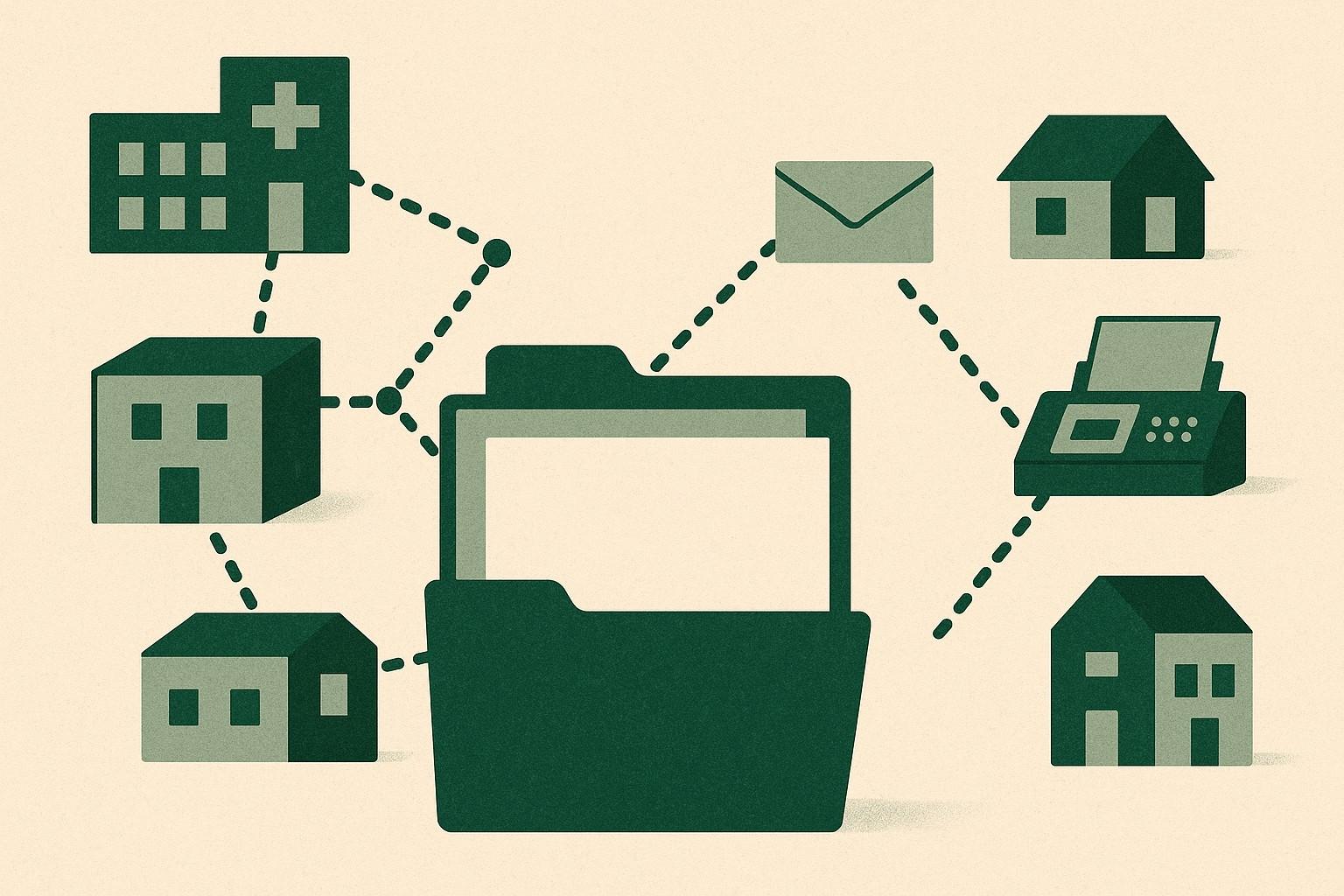
- Many channels. Networks and portals cover part of the record. Fax, mail, email and phone cover the rest.
- Follow-up. Providers answer on their own clock. HIPAA gives a provider 30 days, plus one 30-day extension, to act on a patient's own access request [8]. Requests under an authorization have no federal deadline, so someone has to chase each one.
- Compliance. When a vendor handles patient information for a provider, HIPAA requires a business associate contract that sets the permitted uses and disclosures [7]. The contract must also require appropriate safeguards for electronic records [7].
None of this improves the note. It is staff, queues and phone calls behind the product.
Build, network-only or a retrieval API
Approach | What you build | What comes back | Follow-up | Fits when |
|---|---|---|---|---|
In-house build | Directory, request forms, fax and phone staff, document intake | Whatever your team can reach | Your staff, your cadence | Retrieval is the product you sell |
Network queries only | Network connections and a stated exchange purpose per query [5] | Records from providers on the networks you can query | None beyond re-querying | Treatment use and providers that are well connected |
Retrieval API | One integration: create a request, receive status, download records | Records from networks and from direct provider outreach | Run by the retrieval vendor | You want outside records in the note without a records team |
The network-only path is fast where it works. The gap is the providers it does not reach. A retrieval API that also contacts providers directly covers both.
How a retrieval API fits a scribe product
Tavrn retrieves medical records from any US provider: one authorization in, complete record out, via platform, integration or API. One authorization covers every US provider the patient has seen [9].
Networks, records vendors and portals return about 63% of a patient's visits [9]. Tavrn requests the rest from each provider by fax, mail, email and phone [9]. Every open provider is contacted every 48 hours until it answers [9].
For an engineering team, the request lifecycle is short:
- Create one request per provider under the patient's case, with the signed authorization attached [9].
- A webhook fires on every status change, or poll the request [9].
- Records arrive as each provider responds [9]. Download them with the same key, or take delivery by SFTP or in the Tavrn app [9].
On data use, Tavrn handles protected health information under HIPAA; a BAA is available on request. Tavrn doesn't use the records it retrieves or your organization's data to train AI models.
When building still makes sense
Build if retrieval itself is what you sell, or if your customers only need records from a few connected health systems. Buy if the value of your product is the note, and outside records are an input. In that case the directory, the fax queue and the follow-up calls are cost, not product.
What to do next
See how the request lifecycle works on the health-tech solutions page, or book a demo to walk through the API with your team.
Sources
- 45 CFR 164.506 - Uses and disclosures to carry out treatment, payment, or health care operations — eCFR, 2026-10-19
- Interoperable Exchange of Patient Health Information Among U.S. Hospitals: 2023 (Data Brief No. 71) — ONC (Assistant Secretary for Technology Policy), 2024-05
- Changes in Clinician Time Expenditure and Visit Quantity With Adoption of Artificial Intelligence-Powered Scribes: A Multisite Study — JAMA, 2026-04-28
- Ambient AI Scribes in Clinical Practice: A Randomized Trial — NEJM AI, 2025-12
- Trusted Exchange Framework and Common Agreement (TEFCA) — ONC (Assistant Secretary for Technology Policy), 2026-09-03
- 45 CFR 164.508 - Uses and disclosures for which an authorization is required — eCFR, 2026-10-19
- 45 CFR 164.504 - Uses and disclosures: Organizational requirements — eCFR, 2026-10-19
- 45 CFR 164.524 - Access of individuals to protected health information — eCFR, 2026-10-19
- Medical record retrieval for health-tech companies — Tavrn