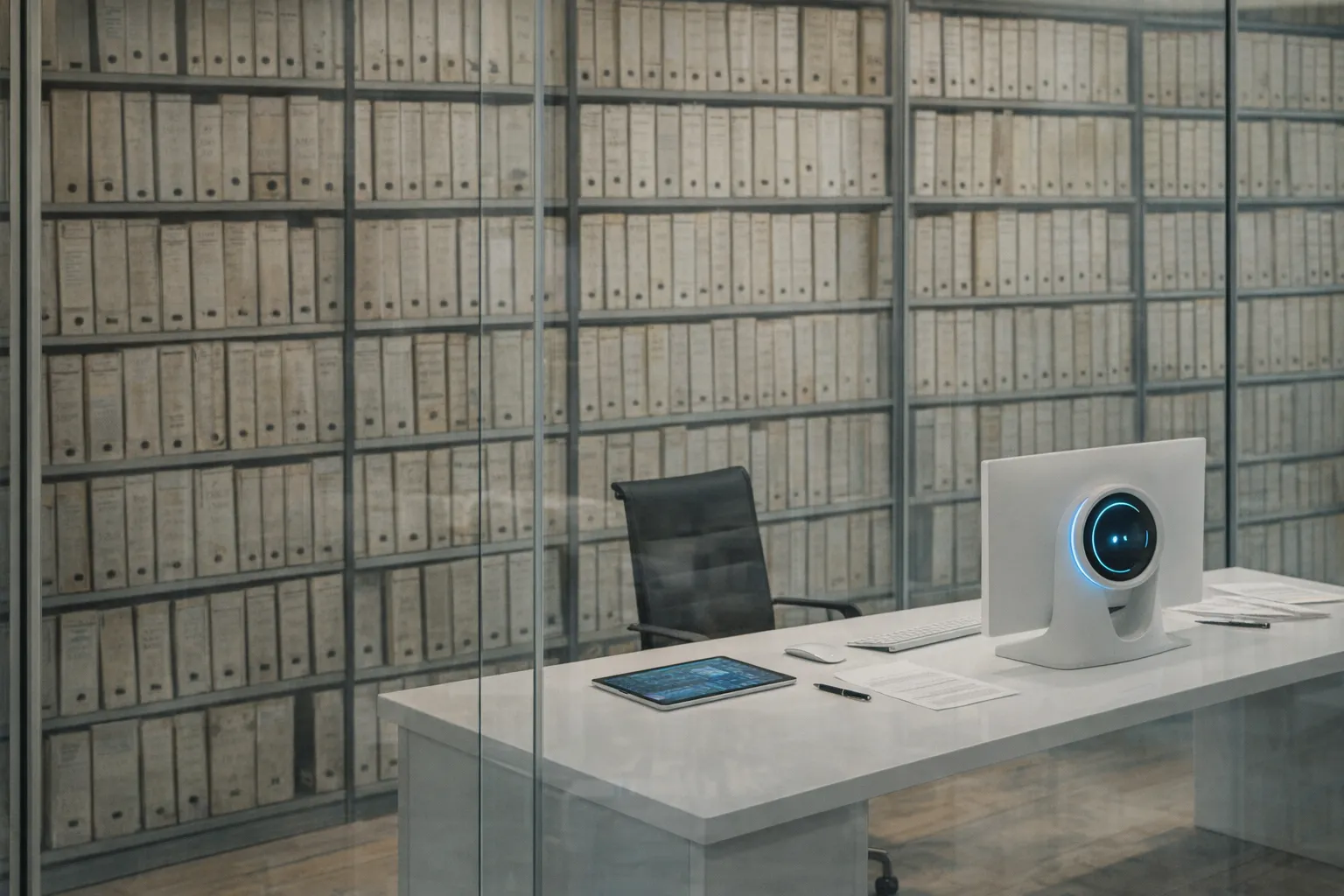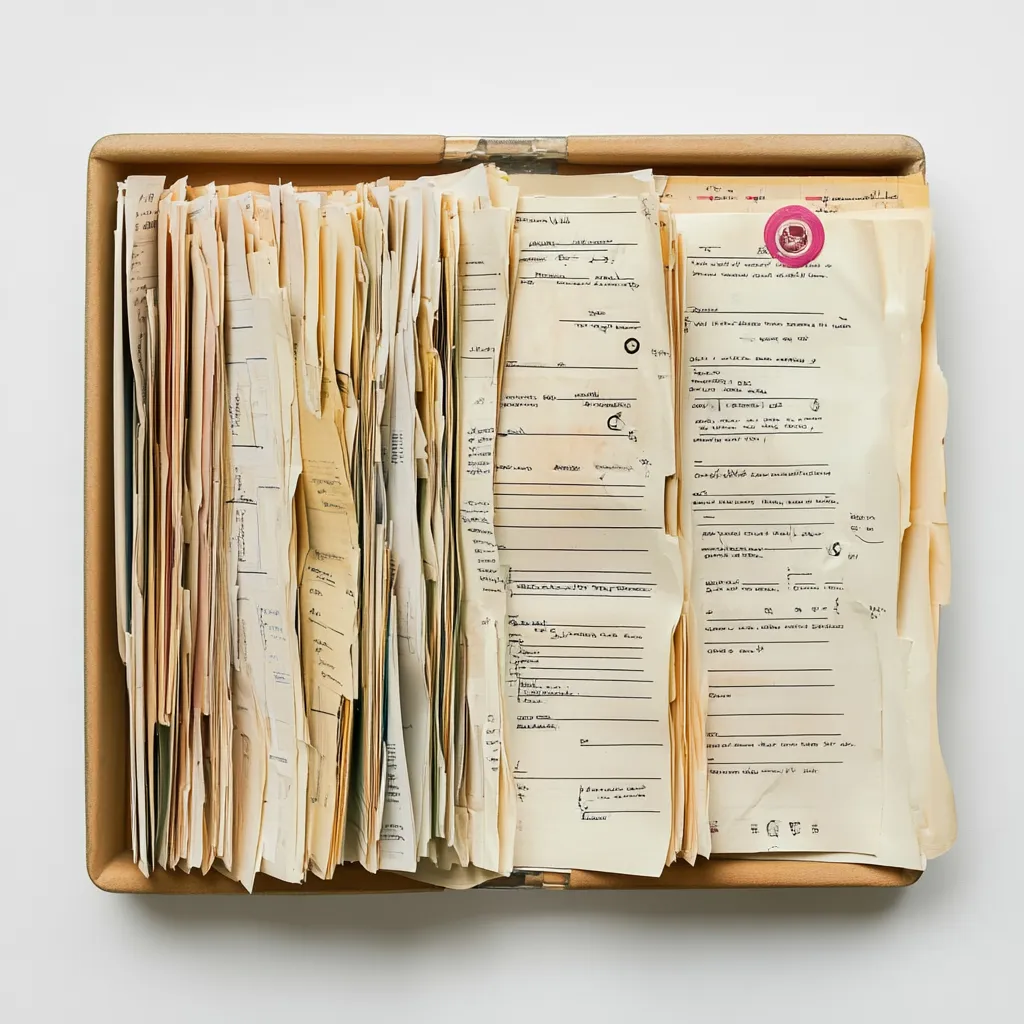
A defense-retained independent medical examination (IME) report's "records reviewed" list may be shorter than the plaintiff's full medical production. Senior paralegals must identify what the examiner never read before the deposition is noticed.
Artificial intelligence (AI) medical record review services for IMEs can convert that production into a deduplicated, page-cited chronology and a document index when the selected system supports those outputs. The same extraction can support related workflows such as records retrieval.
This guide covers record extraction, governing IME requirements, records-list audits, inconsistency flags, human verification, evidentiary support, turnaround time, and the limits of AI-generated chronologies.
What AI Medical Record Review Does With an IME Production
AI-assisted review can turn a medical production into structured data, with results that vary by system and record quality. Common steps include:
- Optical character recognition (OCR) and intelligent character recognition (ICR) in systems that support it attempt to convert scanned and faxed pages, as well as handwriting, to text.
- Deduplication can identify verified duplicate pages or documents for removal and copied-forward text within distinct notes for review without removing the later note.
- Chronology assembly can order the extracted events into a dated timeline.
Reading and extraction generally outperform temporal reasoning, although performance varies by task, dataset, model, scan quality, and handwriting legibility. A 2026 study of OCR paired with generative AI on outside medical records, published in the Journal of the American Medical Informatics Association (JAMIA) Open, reported F1 scores of 0.95 for page segmentation and 0.96 for document classification. Date extraction reached 0.90.
Duplication inflates page counts. Steinkamp et al. reported in JAMA Network Open that 50.1% of clinical text across more than 104 million notes was duplicated from earlier notes about the same patient.
Chronology assembly is the weakest step. In npj Digital Medicine, the temporal-reasoning benchmark study TIMER documented recency bias, with 55.3% of questions referencing only the final 25% of timelines, plus a lost-in-the-middle effect that underrepresents mid-record periods. A page-cited chronology lets a reviewer catch a misanchored relative date, such as "three weeks after the accident," before the sequence reaches a rebuttal expert.
Records Review Duties for IMEs and California Evaluators
The forum determines the audit target. A civil IME's records list should identify what the examiner reviewed or considered, while California regulations govern a qualified medical evaluator's (QME) records list and submissions to an agreed medical evaluator (AME). The applicable regime determines whether an omission is a cross-examination point or a defect in the report itself.
Independent Medical Examination in Civil Litigation
Civil procedure controls how a defendant obtains an IME, not which records the examiner reviews. In federal court, Rule 35 of the Federal Rules of Civil Procedure (FRCP) puts the examination under court control: an order issues only "on motion for good cause and on notice to all parties."
Under California's Code of Civil Procedure (CCP), § 2032.220 lets the defendant demand one nonintrusive physical examination without leave of court, and the demand must name the physician and specialty. Defense counsel typically selects the records it transmits, while the examiner's list should reflect what the examiner actually reviewed or considered, including information from another source.
Qualified Medical Evaluator in California Workers' Compensation
California regulations require a QME to review available relevant records and identify them in the report. The California Code of Regulations (CCR) at 8 CCR § 1 defines a QME as a California-licensed physician appointed by the Administrative Director; QMEs are certified by the Division of Workers' Compensation (DWC) Medical Unit. 8 CCR § 35 requires the sending party to include, served on the opposing party at least 20 days before delivery to the evaluator:
- All records prepared or maintained by the treating physician or physicians.
- Other relevant medical records, including previous treatment.
- A letter outlining the primary treating physician's determination or the issues for the evaluator.
- Relevant non-medical records, including films and videotapes.
Under 8 CCR § 41, the evaluator must review all available relevant records before writing, and "The report must list and summarize all medical and non-medical records reviewed as part of the evaluation."
Agreed Medical Evaluator Selected by Both Sides
An AME is jointly selected in a represented workers' compensation matter. DWC Fact Sheet E describes AMEs as "physicians selected by agreement between the defense and applicant's attorneys," used only when the worker is represented. Because each party's submissions are subject to § 35 service, the review question is whether the combined, deduplicated packet contained every treating record.
How Plaintiff Firms Audit a Defense IME's "Records Reviewed" List
Rule 26(a)(2)(B) requires a covered expert's report to state "the facts or data considered by the witness in forming them." The requirement applies when the examiner is retained or specially employed to provide expert testimony, although conducting a Rule 35 examination alone does not necessarily make an examiner subject to Rule 26(a)(2)(B).
The 2010 Advisory Committee Note reads "facts or data" broadly, requiring disclosure of material considered by the expert "from whatever source, that contains factual ingredients." Rule 26(b)(4)(C)(ii) keeps facts or data that counsel provided and the expert considered outside the work-product shield, while Rule 26(b)(4)(C)(iii) likewise excepts assumptions counsel provided and the expert relied upon. Materials merely sent but not considered, counsel's record-selection rationale, and other attorney-expert communications may remain protected or require redaction.
For an examiner subject to Rule 26(a)(2)(B), the audit runs in sequence:
- Demand the itemization of records the examiner considered and any portions of the transmittal letter containing facts or data considered, or assumptions relied upon, under Rule 26(b)(4)(C)(ii) and (iii).
- Run the full production through a system that supports AI extraction and deduplication, then index every document by provider and date range with its page range.
- Map the IME's "records reviewed" list against that index and flag omitted operative reports, prior treating notes, diagnostic studies, and imaging films.
- Pull each treating-physician finding that contradicts an IME conclusion, with its page citation, for the deposition outline.
- Present the omitted records at deposition and ask what records the physician would review before diagnosing a clinical patient.
- Where a report required by Rule 26(a)(2)(B) fails that rule, move under Rule 37(c)(1); in Johnson v. Friesen, the Eighth Circuit upheld exclusion of causation testimony where the disclosure failures "were neither substantially justified nor harmless."
The sequence only has teeth if the index in step two is complete and page-cited; an omission the defense can dismiss as immaterial at step three becomes harder to wave away once it is tied to a specific missing operative report or diagnostic study by the time it reaches deposition. Built correctly, the same index carries forward into the report and testimony without a second pass through the production.
Which Inconsistencies AI Flags Between IME Findings and Treating Records
Systems offering inconsistency detection can flag four categories and, when they support source linking, connect each flag to the conflicting page. A flag is a lead, not a finding; detection methods carry measured false-positive risk, and causation judgment belongs to the expert.
Treatment Gaps and Their Explanations
Timeline analysis surfaces spans with no encounter and displays the records on either side. The reviewer determines whether a gap reflects recovery, referral delay, loss of insurance, transportation difficulty, or noncompliance. No fixed number of days establishes or defeats causation.
Contradictions With Treating-Physician Notes
Conflict-detection systems compare an IME finding against the treating record for potentially inconsistent findings, flagged for source review. On the BioConflict benchmark, which tests biomedical paper pairs rather than clinical notes, general-purpose large language models (LLMs) reached F1 scores up to 0.89 across 250 expert-annotated pairs. A 2024 arXiv preprint cautions that "Apparent contradictions often require temporal, clinical, or documentation-context reasoning; isolated sentence matching produces false positives."
In practice, that comparison runs on the same body part nearest in time, for example matching an IME finding of full range of motion or no objective deficit against the closest treating note; the reviewer then reads both pages.
Pre-Existing Versus Post-Incident Conditions
A dated chronology, with page references, surfaces prior treatment and history bearing on causation and marks where each condition first appears relative to the incident date. The reviewer and expert then determine whether the record supports aggravation or a new injury and assess apportionment. Imaging findings need particular care because asymptomatic degenerative changes must be distinguished from acute traumatic findings.
Mechanism-of-Injury Mismatches
Mechanism-of-injury review starts with the patient's account in the first post-incident History of Present Illness. A capable system should capture that description verbatim, including its date and Bates reference. An early visit may provide a contemporaneous narrative, although timing and litigation context vary by case. The account can then be compared with the IME report's mechanism or a defense biomechanical opinion that no injury was possible.
Human-in-the-Loop Review: Where Examiner and Attorney Judgment Stays
Bar and medical authorities keep verification and professional judgment with the individual, not the AI system.
New York City Bar Formal Opinion 2024-5 holds that professional judgment "cannot be delegated to [G]enerative AI and remains the lawyer's responsibility at all times," a standard echoed across state bar guidance on generative AI. On the medical side, the American Medical Association (AMA) states plainly that AI "cannot replace physician judgment" and that its clinical use requires "transparency, accountability, and meaningful physician oversight." A rebuttal expert who receives an AI chronology still forms the causation opinion from the records themselves.
Defensibility of AI-Generated Chronologies: Page-Level Citations and Audit Trails
A chronology qualifies as an admissible summary of voluminous records under the Federal Rules of Evidence (FRE 1006) when the underlying writings "cannot be conveniently examined in court," the originals are available to other parties, and the summary passes Rule 403 for accuracy and non-argumentativeness. Courts enforce that accuracy standard directly: in Murray v. Just In Case Business Lighthouse, LLC, the Colorado Supreme Court held that summaries must present the underlying documents "accurately, correctly, and in a nonmisleading manner," and that trial courts abuse their discretion by admitting charts that argue rather than organize. Review platforms that attach source-linked issue flags to treatment gaps and conflicting opinions give the reviewer a page reference for verifying each entry before the chronology reaches an expert or opposing counsel.
Turnaround Speed and Reviewer Hours Compared With Manual Review
AI-assisted first-pass review can reduce reading, indexing, and deduplication hours, but source verification remains necessary regardless of the time saved upstream. The closest empirical benchmark comes from adjacent legal tasks rather than chronology production: Choi, Monahan, and Schwarcz reported in the Minnesota Law Review that 60 law students using Generative Pre-trained Transformer 4 (GPT-4) cut task time by 11.8% to 32.1% across four drafting tasks, with no consistent quality loss. Vendor-specific time-savings claims for medical record review are self-reported and unaudited; the reviewer hours a firm actually keeps go to source-page verification and consultation with the rebuttal expert.
What AI Record Review Cannot Do in an IME Dispute
AI omission studies suggest AI drops facts more often than it invents them, and in an IME rebuttal the dropped fact is the one the defense examiner will exploit.
- Asgari et al. reported in npj Digital Medicine that for GPT-4, 1.47% of 12,999 note sentences were hallucinated, while 3.45% of 49,590 transcript sentences were omitted, roughly double the rate.
- A PLOS Digital Health study found emergency department summary omissions concentrated in two sections central to IME disputes, Physical Examination and History of Presenting Complaint.
Validation on a subset of a production, plus independent review, addresses these failure modes. An analogous AI-evaluation checklist in Frontiers in Digital Health states that "The minimum requirement is at least two independent experts for each review."
A Verified Chronology Is the Working Record for IME Disputes
A Rule 26 or 8 CCR § 41 audit is only as complete as the index behind it. A source-verified chronology, checked against its cited pages, provides the working record for causation and pre-existing-condition disputes.
Tavrn produces medical chronologies that flag treatment gaps and pre-existing conditions and link conflicting opinions to original source pages. Martay Law Office used this approach to absorb record sets exceeding 22,000 pages and grow case filings 65% year over year without backfilling a departed chronology clerk.
To learn more, book a demo.