Last Updated: August 8, 2026
Most personal injury and medical malpractice firms still build timelines by hand, a slow process that consumes paralegal time and delays case evaluation.
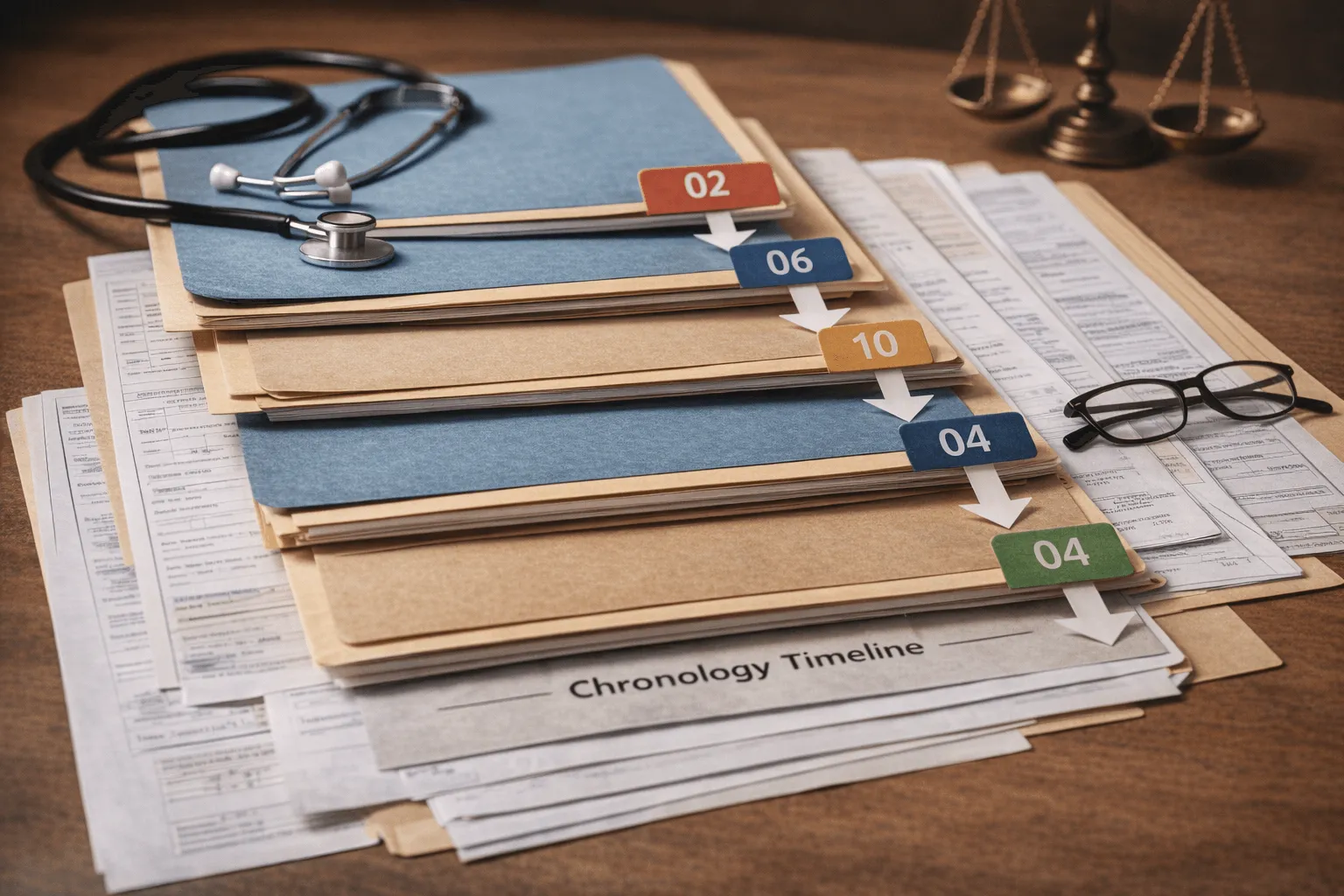
Medical chronology software automates the time-intensive steps of identifying events, organizing timelines, and linking entries to source pages, allowing paralegals to shift from document handling to strategic work.
This guide reviews ten leading tools, explains how AI-powered extraction works, and outlines the criteria firms should apply when evaluating platforms for PI and medical malpractice workflows. Pricing figures below reflect each vendor's own published pricing as of August 2026, and every accuracy or time-savings claim names its source.
How Does Medical Chronology Software Work?
Medical chronology software converts raw medical records into structured legal timelines through an automated workflow. The process begins with secure document upload and OCR, allowing platforms to process PDFs, scanned files, and electronic health records.
AI-powered extraction then identifies critical medical and administrative details, including:
- Patient demographics.
- Treatment dates and encounter history.
- Diagnoses and procedures.
- Provider and facility information.
- Medications and billing codes.
The extraction process mirrors the manual triage steps paralegals traditionally follow, identifying key events, surfacing inconsistencies, and flagging details that require further review. Chronology software organizes these elements into structured timelines, even in matters involving multiple providers or overlapping treatment periods.
The software produces formatted chronologies with hyperlinks to source pages, supporting verification and legal defensibility. Human oversight remains essential to catch common extraction errors in extracted events, dates, and provider details.
What Should Law Firms Look for in a Chronology Platform?
Firms comparing software against an outsourced provider should focus on three core dimensions: accuracy, security, and end-to-end workflow capability.
Accuracy Remains the Primary Criterion
Extracted events, dates, and provider details must match source documents with verifiable precision. Side-by-side testing against actual case files is the only reliable signal, because no independent benchmark of medical chronology AI accuracy currently exists. Every accuracy percentage published in this category comes from the vendor's own internal testing, with no disclosed methodology and no third-party validation, so those figures cannot be compared against each other.
Verifiability matters as much as raw accuracy. In a survey of 207 US personal injury attorneys and firm leaders conducted by the research firm Thirdside and published by Supio in a July 2026 survey, 99% of attorneys said they will not use AI-generated content they cannot verify, and 96% reported being very or extremely concerned about output that cannot be traced back to a source. Supio is a vendor in this category, so treat the framing accordingly, but the finding points to a practical requirement: every timeline entry should link to the page it came from.
Security and Compliance Requirements Exceed Those of Standard Business Tools
Chronology platforms handling protected health information should provide:
- HIPAA Business Associate Agreements.
- SOC 2 Type II audit reports.
- Encryption for data at rest and in transit.
- Audit logs tracking all access activity.
Legal ethics guidance frames vendor vetting as a general duty of diligence rather than a checklist of named controls. ABA Model Rule 1.6(c) requires lawyers to make reasonable efforts to prevent unauthorized disclosure of client information. ABA Formal Opinion 512 (2024) directs lawyers to read and understand the terms of use, privacy policy, and related contractual terms of any generative AI tool they use, and treats understanding a vendor's security policies as part of that diligence. ABA Formal Opinion 483 (2018) addresses the duty to monitor external vendors and to notify a client when a breach occurs.
The ABA does not name SOC 2 reports or business associate agreements in any of these authorities. Those are industry practices firms use to satisfy the general obligation, and independently reviewing a vendor's SOC 2 report remains the most direct way to test a security claim rather than accept it.
End-to-End Workflow Capability Is Increasingly Important
Chronology tools that extend beyond timeline generation, such as supporting intake processes, record organization, and downstream documentation needs, offer more cohesive case-preparation workflows. Platforms that streamline adjacent tasks reduce fragmentation and help litigation teams maintain consistent evidence handling across the lifecycle of a PI or med mal matter.
Tools Compared at a Glance
Pricing verified against vendor-published pages, August 2026. Turnaround reflects only what each vendor publishes; "Not published" means the vendor states no figure. Note that most tools in this category generate chronologies from records the firm already has, and only a subset retrieve those records in the first place.
The 10 Best Tools for 2026
Firms evaluating medical chronology tools should understand how leading platforms differ in accuracy, workflow integration, and overall case preparation impact. The list below is ordered by fit for plaintiff-side PI and medical malpractice work rather than by company size or funding. Entries note where a tool primarily serves insurer or claims workflows, since output style differs between plaintiff and defense use.
1. Tavrn
Tavrn is an AI-powered medical record retrieval and chronology platform built specifically for contingency-fee practices. Retrieval and chronology run in the same system, so records arrive organized and ready for timeline building rather than requiring a handoff between vendors.
Key features:
- End-to-end workflow: provider request, organized records, AI chronology, demand drafting.
- Native record retrieval rather than a retrieval partnership.
- AI chronologies with hyperlinked entries tied to source pages.
- Duplicate record removal within chronology output.
- Automated record organization and naming on delivery.
- Centralized dashboard for tracking provider responses and inbound documentation.
- Built exclusively for PI, med mal, and disability workflows.
Strengths for PI and med mal workflows:
- Chronology quality depends on record completeness, so owning retrieval upstream removes the most common cause of thin or gap-ridden timelines.
- Sub-24-hour turnaround supports case evaluation and demand drafting on a working schedule rather than a multi-day wait.
- Built for contingency-fee economics rather than billable-hour workflows, which shapes both pricing structure and turnaround priorities.
Documented firm outcomes: Levine Benjamin, which manages 800 to 1,000 record requests per month, reported 3x faster turnaround and a 90% reduction in firm-wide paperwork. Paul LLP, a complex litigation practice sourcing records from hundreds of facilities, cut paralegal time on record requests from multiple full days per week to roughly 1 to 2 hours per week.
Compliance: SOC 2 Type II certified, with AES-256 encryption at rest, TLS 1.2 in transit, multifactor authentication and SSO enforcement, and a commitment that client data is never used to train AI models.
Pricing: Available on request.
Best for: Contingency-fee PI and med mal firms that want a single solution for retrieval, record organization, and chronology generation.
2. EvenUp
EvenUp offers MedChrons, a chronology product within its broader claims platform. Output is an interactive, color-coded timeline rather than a static document, and every chronology passes through review by EvenUp legal professionals before delivery.
Key features:
- Color-coded, searchable treatment timeline with one-click jump to the underlying record.
- Surfaces diagnostics, ICD codes, and treatment milestones.
- Flags treatment gaps, pre-existing conditions, and diagnostic inconsistencies.
- Flags prior treatment and history that may affect causation.
- Reviewed by legal professionals, with optional nurse review for clinical accuracy.
- Integrations with Litify, SmartAdvocate, and CASEpeer.
Strengths for PI and med mal workflows:
- Optional clinical review suits firms without in-house nursing support.
- Causation-relevant flagging aligns with plaintiff-side case evaluation.
Considerations:
- Clinical nurse review is optional rather than standard, so causation-sensitive files may need an add-on.
- Duplicate record handling is not documented publicly.
- Broad platform play may exceed the needs of a firm wanting a standalone chronology tool.
Compliance: EvenUp reports a SOC 2 Type 2 examination and a HIPAA compliance assessment, with annual third-party penetration testing and reports available on request. Business associate agreement availability is not documented publicly.
Pricing: Quote only. EvenUp publishes no list, per-page, or per-chronology pricing and describes its model as case-based.
Best for: PI firms that want an AI chronology with an optional clinical review layer and already use Litify, SmartAdvocate, or CASEpeer.
3. Supio
Supio generates medical chronologies through its agent-based document platform, with human subject matter experts verifying every chronology before final delivery. Firms receive an immediate working timeline first and a verified version afterward.
Key features:
- Instant working chronology on upload, followed by human-verified output.
- Every event links to the original source document.
- Search and filter by date range, provider, injury type, and treatment.
- Detects connections across records, such as linking an arm injury to related neck or back findings.
- Extraction across records, bills, voice, text, email, and video.
- Integrations with Filevine, Litify, and SmartAdvocate, plus an API.
Strengths for PI and med mal workflows:
- Mandatory human verification suits firms that will not rely on unreviewed AI output.
- Multi-format extraction handles mixed evidence sets common in mass tort matters.
Considerations:
- Human verification adds time; the verified timeline arrives within several business days rather than immediately.
- Record retrieval is not native, so retrieval runs through a partner rather than the same platform.
- Encryption standards and business associate agreement availability are not specified publicly.
Compliance: Supio reports SOC 2 Type II certification and states it maintains the controls required for HIPAA, PHIPA, and GDPR, with continuous monitoring, US, UK, and Canadian data residency, and a commitment that client data never trains foundation models.
Pricing: Quote only. Supio publishes no pricing on its own site.
Best for: High-volume PI and mass tort teams that want human-verified chronologies and source-linked entries.
4. Filevine MedChron
MedChron is Filevine's native chronology engine, built directly into the Filevine case-management platform. It generates AI-driven timelines, classifies records, and links entries to uploaded documents.
Key features:
- AI extraction of dates, providers, diagnoses, and treatments.
- Automatic record classification within Filevine.
- Hyperlinked timeline entries for quick verification.
- Dynamic visual timelines highlighting treatment patterns and delays.
- AI-generated summaries for rapid case assessment.
Strengths for PI and med mal workflows:
- Deep native integration removes the need for external chronology tools.
- Automated classification and timeline creation cut setup work on complex matters.
Considerations:
- Only available to Filevine users.
- Firms using a separate document management system may duplicate tasks.
- Missing-record and gap detection is not advertised, unlike several competitors.
Compliance: Filevine reports completed SOC 2 Type II, HIPAA, and HITECH audits.
Pricing: Filevine does not publish pricing. Its June 2025 launch announcement remains the only public statement on MedChron cost: free for Filevine customers with Filevine AI, an add-on for those without it, and a single-use free trial covering the first 1,000 pages for non-Filevine users. Base platform pricing is quoted per firm, and third-party per-user figures circulating online are estimates rather than published rates.
Best for: Firms already standardized on Filevine that want built-in chronology automation without adopting a standalone tool.
5. InPractice AI
InPractice AI is a standalone medical record review and chronology platform with summarization, duplicate detection, and document comparison capabilities. It is used across legal, insurance, and claims workflows.
Key features:
- AI-generated medical summaries and chronologies.
- Side-by-side record review with customizable output formats.
- Automatic hiding of exact duplicate records.
- Search and filtering across events, diagnoses, and providers.
- Processing at roughly 2 to 3 seconds per page, with 1,000 pages completed in under an hour.
Strengths for PI and med mal workflows:
- Per-page pricing with no subscription offers predictable costs for case-by-case needs.
- Credits do not expire, which suits firms with uneven case flow.
Considerations:
- Built for insurer and claims workflows, so plaintiff firms should verify the output style fits litigation needs.
- Per-page costs scale quickly on mass tort or multi-year treatment files.
- Volume tier breakpoints are not published, so the effective rate requires a quote.
Compliance: HIPAA compliant per the vendor.
Pricing: From $0.05 per page, with no subscription required and unlimited users.
Best for: Firms needing a flexible, standalone chronology and summarization tool without adopting a new case-management system.
6. Wisedocs
Wisedocs is a high-volume medical record processing and chronology platform built for organizations handling large, complex claims. It emphasizes speed, structure, and collaboration.
Key features:
- Automated chronologies organized by date, provider, and category.
- Intelligent OCR for scanned and low-quality PDFs.
- Automatic deduplication of records.
- Treatment gap and conflicting finding detection.
- Collaborative workspaces for multi-user review.
- Workflow and API support for high-volume operations.
Strengths for PI and med mal workflows:
- Strong fit for mass tort or large dockets with heavy record volume.
- Structured chronologies support expert review and causation analysis.
Considerations:
- Oriented toward insurers and independent medical examination vendors, so plaintiff firms should test output style.
- Enterprise packages may exceed what small PI firms require.
- No published turnaround figure.
Compliance: Wisedocs reports SOC 2 Type II with zero findings, plus HIPAA and PIPEDA compliance.
Pricing: Available on request.
Best for: High-volume PI, med mal, or mass tort practices needing large-scale chronology creation and record indexing.
7. Superinsight
Superinsight is a privacy-focused AI medical chronology platform emphasizing fully automated processing with no human reviewers. It supports chronology creation, activities of daily living documentation, and nexus evidence for disability and injury matters.
Key features:
- AI-generated chronologies identifying visits, diagnoses, medications, and providers.
- Fully automated processing with no human reviewers touching records.
- Flexible export formats including PDF, DOCX, and CSV.
- Tools for identifying missing records and incomplete documentation.
- Support for activities of daily living and nexus evidence workflows.
- Reported turnaround of 15 to 30 minutes per chronology.
Strengths for PI and med mal workflows:
- Suits firms prioritizing privacy and automated processing over outsourced review.
- Useful for disability-oriented or complex impairment cases requiring functional documentation.
Considerations:
- A pure AI approach requires internal attorney or paralegal quality assurance.
- Credits expire after 30 days, which penalizes uneven case flow.
- Superinsight's own pages quote conflicting per-chronology figures, ranging from $28 to $54 in one place and $28 to $125 in another, while the actual purchase model is credit-based. Confirm pricing directly.
- No SOC 2 report is advertised.
Compliance: Superinsight advertises HIPAA compliance and encryption. Audit logging is not documented on its security materials.
Pricing: Credit subscription starting at $250 per month for 6 credits, roughly two personal injury reports, and $500 per month for 18 credits. Credits expire after 30 days.
Best for: PI, disability, and med mal teams that want privacy-centered, exportable chronologies without human outsourcing.
8. CaseMark
CaseMark is an AI-powered legal document summarization platform that produces medical chronologies in multiple formats, including detailed, injury-focused, and treatment-focused versions, alongside narrative summaries and broader litigation-summary tools.
Key features:
- AI-generated chronologies with multiple format options for PI and med mal cases.
- Source page citations for every extracted entry.
- Gap analysis identifying missing records and treatment periods.
- Pre-existing condition versus post-incident injury distinction.
- Court-ready PDF output with attorney work product designations.
- Access to a large library of legal agent workflows.
Strengths for PI and med mal workflows:
- Multiple chronology formats let teams match output to case type.
- Source citations on every entry support verification.
Considerations:
- Pricing moved from per-page to a credit-based subscription, so high-volume months can trigger overage charges at then-current rates.
- Business associate agreements are available only on the Enterprise tier.
- Broader summarization platform, so firms wanting medical-only specialization should evaluate depth.
Compliance: CaseMark reports a SOC 2 Type II audit and HIPAA-aligned infrastructure, with business associate agreements available at the Enterprise tier.
Pricing: Workspace from $100 per user per month, including $80 in monthly AI credits per user. Team and Enterprise tiers are custom. Usage beyond included credits is billed at then-current rates. The former $0.10 per page medical chronology rate is no longer offered.
Best for: PI and med mal teams that want flexible chronology format options alongside broader litigation-summary tooling in one platform.
9. DodonAI
DodonAI is a broad legal-document AI platform that includes medical chronologies, medical bill analysis, police report summaries, deposition summaries, and independent medical examination report summaries. It is a multi-workflow tool rather than a pure medical chronology engine.
Key features:
- AI-generated medical chronologies in narrative and tabular formats.
- Deposition, IME, police report, and bill-analysis tools in the same system.
- Flags inconsistencies and treatment gaps.
- Search and filtering across events, dates, and providers.
- Designed to support deposition prep, mediation strategy, and trial storytelling.
Strengths for PI and med mal workflows:
- Consolidates chronologies, bill analysis, and deposition summaries in one platform rather than across vendors.
- Narrative chronologies are useful for mediation statements and strategy briefs.
- Entry pricing is among the lowest in this comparison.
Considerations:
- Less specialized for medical-only use cases, so depth may vary against medical-specific tools.
- Entry tiers carry page caps, so heavy-volume matters move into higher tiers quickly.
Compliance: DodonAI advertises SOC 2 certification, HIPAA compliance with signed business associate agreements, AES-256 encryption, and no training on client data.
Pricing: From $25 per month billed annually, or $30 per month, with volume tiers scaling upward. Entry tiers include page limits.
Best for: Litigation teams who want a single AI tool for medical chronologies and related litigation summaries rather than a dedicated medical-only solution.
10. Casefleet
Casefleet is a litigation fact-management platform with timeline tools that integrate documents, witnesses, and facts. It is not medical-specific, but PI firms use it to manage complex causation and multi-event cases.
Key features:
- Interactive timelines linking facts, documents, and witnesses.
- Advanced filtering, tagging, and search across large factual datasets.
- Document review with linked evidence and annotations.
- Visualization tools for case narrative development.
- Case management components including contacts, tasks, and notes.
Strengths for PI and med mal workflows:
- Handles cases requiring integrated medical and non-medical timelines, including accidents, employment history, and witness statements.
- Useful for deposition prep, trial strategy, and multi-defendant litigation.
Considerations:
- Does not automatically parse or extract data from medical records, so manual entry is still required.
- Firms needing automated chronology generation will need a second tool.
- AI document processing sits on the higher-priced tier, with metered overages beyond included pages and credits.
Pricing: Starter from $30 per user per month billed annually, or $40 monthly. The Advanced AI tier, which includes document intelligence and AI credits, is $140 per user per month billed annually, or $180 monthly. Enterprise pricing is custom.
Best for: PI and med mal litigation teams handling complex factual cases who need detailed fact management and visual timeline tools.
How Should Law Firms Choose the Right Medical Chronology Software?
Selection criteria matter more than feature counts, because most platforms in this category now advertise overlapping capabilities. The differences that affect daily work sit in accuracy, integration reliability, and oversight rather than in feature lists. Before committing, firms should work through a six-point checklist.
1. Test Accuracy With Real Case Files
Platform selection should begin with accuracy testing using actual medical records, not vendor demos. Establish baseline metrics against a consistent quality baseline, including current chronology creation time, attorney-verified accuracy rates, and cost per page compared with manual review.
2. Assess Integration Reliability
Reliable API connections, stable data synchronization, and direct access from case management systems prevent workflow disruptions. Poorly integrated tools often fail to deliver measurable value regardless of standalone capability. Several tools in this comparison integrate only with specific case management platforms, so confirm compatibility before shortlisting.
3. Verify Security and Compliance
Chronology tools handling protected health information require SOC 2 Type II audit reports, HIPAA business associate agreements, and encryption at rest and in transit. Several vendors in this category advertise HIPAA compliance without a corresponding SOC 2 report, and some do not document business associate agreement availability at all.
4. Evaluate Workflow Fit and Oversight
Tools should reduce document processing time while preserving paralegal oversight. Annotation, flagging, and override capabilities keep human reviewers in control of accuracy, legal analysis, and causation assessment. Firms should decide up front whether they want fully automated output, output verified by the vendor, or a hybrid, because that choice affects both turnaround and cost.
5. Confirm Vendor Stability
Vendor viability matters as legal AI evolves. Evaluate customer references, years serving law firms, and update frequency. Contracts should include performance benchmarks, accuracy commitments, and flexible early termination terms. Pricing in this category shifted between 2025 and 2026, with several vendors moving from per-page to credit-based models, so confirm terms directly with the vendor.
6. Estimate Implementation and ROI Against an Internal Baseline
No independent research quantifies implementation timelines or return on investment for medical chronology software in PI and med mal practice. Vendor figures offer a starting reference point: Filevine has stated that complex chronologies traditionally required 15 to 20 hours of manual effort per case. That is a vendor estimate with no disclosed methodology, so it works only as a prompt to measure current in-house hours per chronology, then compare that against tool cost and reviewed output quality after a trial period.
Why Law Firms Choose Tavrn for AI Chronologies
Accurate medical chronologies depend on the completeness and organization of the underlying records. No AI tool compensates for missing documentation, delayed provider responses, or inconsistent formats, which is why the choice between sending records out and running retrieval in-house often determines timeline quality.
Martay Law Office, a high-volume Illinois workers' compensation practice, adopted Tavrn after the clerk who built its chronologies departed. Tavrn retrieved records in days and delivered organized files ready for chronology creation, and the full breakdown shows the firm processed record sets exceeding 22,000 pages in minutes and grew filings 65% year over year without backfilling the role.
To learn more, book a demo.