Most coverage of medical records automation focuses on clinical documentation. PI and medical malpractice firms face a different problem: large record sets arrive after care, and slow or imprecise processing can affect settlement posture and case capacity.
Automating medical records to save time and reduce errors in litigation requires a different framework than clinician-side tools. In legal workflows, a thorough medical record review process depends on speed and accuracy operating together, not as separate efficiency targets.
This article examines where manual workflows produce delays and errors at the same time, how automation addresses both dimensions, and where the operational gains appear in PI and medical malpractice case preparation.
What Does Automating Medical Records Mean for PI and Med Mal Firms?
Search results for medical records automation often center on clinician-side tools such as voice transcription, EHR integration, and chart summarization for treating providers. Legal teams work in a different context. Legal-side medical records automation is the use of software to retrieve, index, organize, and summarize a claimant's existing records for litigation, rather than to document care as it happens. The workflow spans retrieval from medical facilities, intake and indexing, chronology assembly, summary generation, and gap identification.
A single matter can involve hundreds to thousands of pages of records pulled from multiple facilities and treatment periods, which is a different scale and structure than the clinician-side documentation those records originated from.
The stakes compound at every stage. A missed treatment date or transcription error in indexing can carry through chronologies, summaries, and demand calculations. In this context, downstream processing is not just administrative overhead. It can affect case preparation quality, defensibility, and negotiation posture.
Why Manual Medical Records Work Creates Both Delays and Errors
Manual processing forces a tradeoff between speed and accuracy that degrades the workflow at both ends. This tradeoff is structural rather than a training issue. It plays out daily in paralegal workflows and compounds across the stages of case preparation that depend on accurate record-keeping.
How This Plays Out in Daily Workflow
When volume rises, speed accommodations follow: skimming records, batching reviews, and deferring verification. Each accommodation increases the chance of a missed treatment date, a misread abbreviation, or a gap that appears later during deposition prep or demand drafting.
For senior paralegals carrying a full caseload, the pattern is familiar. Most of the workday goes to document processing rather than legal analysis, and the backlog grows as new matters arrive faster than existing files can be cleared. The risk that surfaces later, during demand letter preparation or deposition prep, is the treatment date or provider visit that was overlooked when there was no time to verify it.
For operations leaders tracking turnaround time and error rates as separate metrics, both numbers often stem from the same operational constraint. Addressing one without addressing the other produces limited returns.
Error Compounding Across Case Preparation
In a legal medical record review, a small indexing or extraction mistake can travel downstream into chronology entries, summaries, and damages analysis. That compounding effect is one reason manual records work can create both delay and rework at the same time.
The practical risk is not limited to one bad field entry. Once a wrong date, omitted provider visit, or incomplete treatment sequence enters the case file, later review stages may spend additional time correcting the record before the matter is ready for demand, mediation, or litigation.
How Does Automation Reduce Time and Errors Simultaneously?
Each stage of the automation pipeline can support both speed and accuracy through a single structural mechanism: shifting repetitive classification and extraction work away from time-pressured human review while preserving human judgment for legal significance. Direct legal-workflow error-rate benchmarks remain limited, but adjacent research is instructive: a 2025 multi-center study in Critical Care found that optical character recognition cut data-entry time by about 44 percent while reaching 96.9 percent accuracy across independent validation. The setting is clinical rather than legal, but the mechanism, moving structured capture off manual keying, is the same one that operates in records-heavy legal review.
Retrieval Automation
Record retrieval is often the first source of delay in case preparation, and downstream teams usually cannot begin meaningful chronology work until the file is complete enough to review. Intake delays also create opportunities for matter-assignment mistakes, naming inconsistencies, and missing follow-up steps.
Automation can streamline intake, routing, and follow-up so records arrive attached to the correct matter with less staff handling. That can reduce intake delays and some transcription errors, even while provider response times still vary.
Indexing and Structured Extraction
Medical records often arrive in inconsistent formats across providers, ranging from electronic exchange to fax and mail. Network-based electronic methods have risen steadily among hospitals while mail and fax declined, per ASTP/ONC survey data through 2025, but non-electronic exchange has not disappeared, so legal teams still receive mixed-format record sets. Automated indexing uses OCR to convert scanned PDFs and similar unstructured documents into machine-readable text, then extracts structured data points such as dates, diagnoses, medications, procedures, and provider names.
This page-level data capture replaces manual re-keying. It can also reduce interpretive variance across different reviewers because the extraction logic applies consistently regardless of fatigue or time of day.
Chronology Assembly with Source Citations
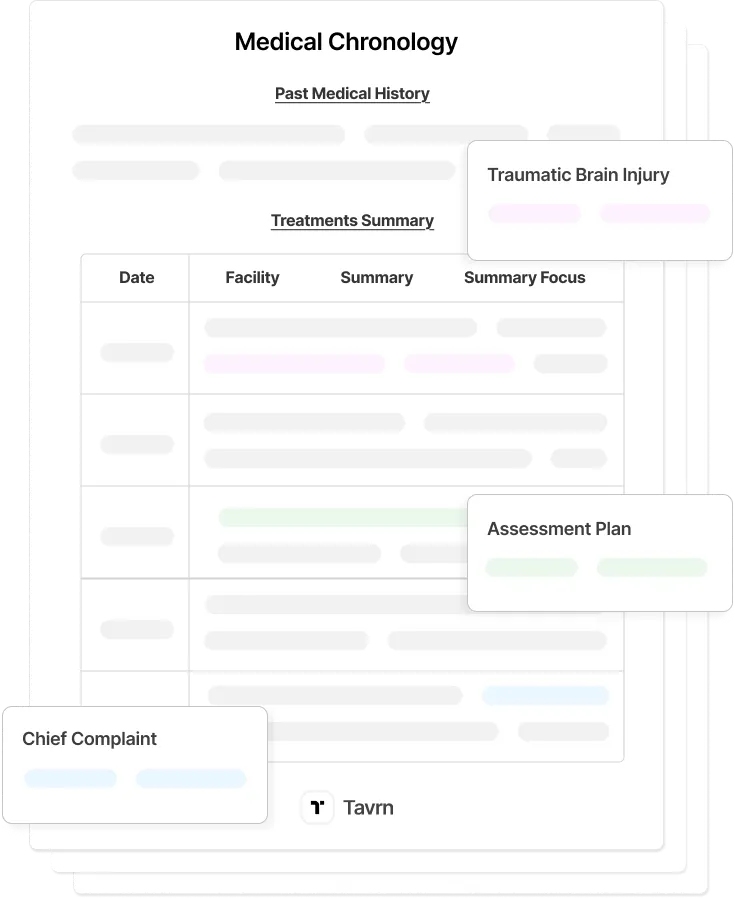
Chronology assembly is a high-value automation target because it turns extracted data into a draft timeline. Systems can identify milestones, arrange events chronologically, and link each extracted fact to its source document and page number.
Source-linked citations function as quality control. Instead of relying on a manually typed summary, the reviewer can move directly back to the record for verification.
This loop matters because medical-legal review is built on traceability. A chronology entry that cannot be traced back to a specific page in the original record set is harder to defend during expert consultation, adjuster negotiation, or deposition preparation. Manually typed chronologies often lose that connection within a few review cycles, when paralegals working under volume pressure paraphrase or compress source material. Page-linked entries hold the connection through every downstream stage, which keeps the chronology usable as the working reference document for the matter.
Summary Generation and Gap Identification
Automated summaries follow a more consistent structure across cases, which can make contradictions and missing information easier to spot during attorney review. Paralegals then shift from manual extraction to reviewing outputs, handling exceptions, and applying case-specific judgment.
Consistent structure also makes summaries easier to delegate and review across a team. When every case file uses the same format, junior paralegals can be onboarded faster, attorneys can locate specific sections without re-learning each case's layout, and quality review becomes a structural check rather than a free-form read. Gap identification benefits from the same consistency: missing imaging reports, undocumented specialist consultations, or treatment sequences that stop without explanation surface earlier in the workflow, when they can still be addressed rather than rediscovered at the demand or deposition stage.
The larger gains come from changing how dependent tasks sequence around automated outputs, not from speeding up any single task in isolation.
Where Time and Error Improvements Show Up in Case Economics
The operational effects of automating medical records to save time and reduce errors matter because they influence demand timing, staff capacity, and review defensibility. The strongest support in this article is for workflow speed, completion, and review consistency rather than for a single universal error-reduction benchmark.
Demand Letter Lead Time
The interval between record receipt and demand readiness shapes how quickly a case can move toward settlement. Comprehensive medical review can strengthen the signal that a claim is supported by objective evidence.
Faster chronology and summary production may shorten this interval without sacrificing the completeness that supports demand strength.
That compression has compounding effects across the firm. Hours that previously sat in chronology and summary assembly become available for intake on new matters or for substantive legal analysis on existing ones. When demand turnaround moves from weeks to days, settlement velocity increases without changes to headcount or case mix, and the matters that close faster free attention for the next round of intake. The operational gain shows up at the firm level rather than the individual case level.
Case Capacity
When paralegals spend less time on manual indexing and chronology construction, firms may be able to handle more matters concurrently. Capacity gains do not come only from faster individual tasks. They come from reducing the backlog that forms when retrieval, intake, chronology, and summary work all depend on the same limited staff time.
That backlog has a specific shape. Retrieval requests pile up behind intake, intake piles up behind chronology assembly, and chronology piles up behind summary generation. Each stage waits on staff time held by the previous one, which is why adding paralegals without addressing the underlying workflow produces diminishing returns. Removing manual processing from the early stages releases capacity across all of them at once, since the same hours that move retrieval forward also become available for chronology and summary review.
Defensibility and Traceability
Structured outputs with page-level citations can strengthen review traceability in mediation, deposition prep, and adjuster negotiation. They can also improve defensibility if a review later comes under scrutiny.
This matters because legal judgments about case value often depend on the completeness and traceability of the underlying record review. Documented review processes are easier to defend than memory-dependent manual workflows.
The scenarios where traceability is tested are predictable. Adjusters challenge specific treatment dates or damage entries. Opposing counsel questions the completeness of the medical record set during deposition. Expert witnesses ask for the source page behind a chronology line before forming an opinion. In each case, the time required to defend or substantiate the entry is the difference between maintaining a negotiating posture and losing it.
Automation as a Structural Correction for Medical Records Workflows
Time and error reduction in medical records workflows share an operational source. The speed-accuracy tradeoff is a structural feature of high-volume manual review, and automation can improve both dimensions by shifting repetitive processing away from time-pressured review. Even as electronic exchange expands under frameworks such as TEFCA, fax and mail persist, so legal teams still receive mixed-format record sets that require structured processing.
Tavrn describes its platform as handling the medical records pipeline for PI and medical malpractice firms, with source-linked outputs designed for attorney review and litigation readiness. Related AI-powered case preparation content explains how that workflow fits into case preparation. Illinois firm Martay Law Office grew case filings 65 percent year over year after adopting Tavrn to process record sets exceeding 22,000 pages without added headcount.
To learn more, book a demo.