Paralegals at PI and medmal firms often encounter EMR names first on release-of-information forms. Epic may appear on a hospital authorization, Oracle Health on a faxed coversheet, and eClinicalWorks on a clinic intake portal. The system behind a request often affects fulfillment speed and production format.
This article is a paralegal reference to the medical electronic record systems most commonly seen in PI and medmal files. It focuses on what each platform means operationally for teams handling record requests and processing productions downstream.
The sections below cover the EMR-EHR distinction, 10 systems commonly encountered in legal workflows, and how those records move from provider export into case preparation.
What Is an Electronic Medical Record System?
Electronic medical record systems are digital documentation platforms used by healthcare providers to record and store patient health information during clinical care. As the ONC describes them, EMRs are digital versions of the paper charts maintained in clinicians' offices, clinics, and hospitals, used primarily by providers for diagnosis and treatment. These systems organize clinical data into structured categories that form the basis of a patient's legal health record. The core data types include:
- Encounter notes
- Diagnoses
- Medications
- Lab and imaging results
- Treatment histories
- Billing data
The distinction between EMR and EHR matters for legal record requests, even though the terms appear interchangeably on ROI forms. An EMR is the digital chart within a single practice or institution, owned by that care delivery organization. An EHR is designed to move data across providers and follow patients between settings.
Checking "EHR" on a form does not usually change what the provider produces in response to a legal records request, because ONC describes EHRs as spanning more than one healthcare organization, while each provider's system generates its own legal health record. Records from each treating organization still require a separate ROI request directed to that organization.
The Top 10 EMR Systems Most Common in Legal Medical Records
The systems below are included for their relevance to PI and medmal record workflows. Each entry covers the vendor profile, ROI process, export formats, and operational details that affect downstream record handling.
Epic Systems
Epic Systems, founded in 1979 and headquartered in Verona, Wisconsin, is widely deployed across academic medical centers and large integrated delivery networks.
Many large Epic hospitals outsource ROI fulfillment to Datavant or MRO. MyChart provides patient-side access, but legal professionals are not typically a portal proxy category for attorney-initiated record requests.
Output often arrives as large PDF bundles organized by record section, not chronologically across document types. Audit trail availability is relevant for medmal documentation-timing claims, but audit logs are not included in standard productions and must be requested as a separate line item. In multi-facility cases, productions may or may not include Care Everywhere-imported records from other facilities, so that scope often requires separate confirmation.
Best for: Hospital records from large academic medical centers, integrated delivery networks, and major metropolitan health systems.
Pros:
- Audit trail and metadata infrastructure supports medmal documentation-timing claims when requested as a line item
- ROI fulfillment is often centralized through third-party vendors with established legal-request workflows
- Care Everywhere imports can surface records from other facilities within a single production when the scope is confirmed
Cons:
- Standard productions exclude audit logs, requiring separate line-item requests
- PDF bundles organized by record section often need date-based re-sorting before chronology assembly
- Multi-facility productions may inconsistently include Care Everywhere-imported records, requiring scope confirmation
Oracle Health (Formerly Cerner)
Oracle Health, originally founded in 1979 as Cerner Corporation in Kansas City, Missouri, was acquired by Oracle in 2022. The platform appears across large health systems and federal healthcare environments, including the Department of Veterans Affairs and Department of Defense, though some institutions still operate in mixed environments.
At VA sites not yet migrated to the Federal EHR, the legacy VistA system remains operational, creating a dual-format records environment.
ROI varies significantly by institution. Patient portal access is institution-specific, and records handling may differ across facilities, making provider-specific confirmation important before service or follow-up.
Best for: Records from federal healthcare facilities (VA, DoD), large health systems, and institutions with deep platform customization.
Pros:
- Federal facility records often include detailed military and service-related documentation relevant to specific case types
- Standardized PDF formats produce consistent baseline output across most institutions
- Cerner Millennium platform supports comprehensive clinical documentation across long care histories
Cons:
- VA dual-format environment requires confirming whether records are produced from VistA, Cerner, or both
- Institution-specific customization means ROI processes and export formats vary widely between facilities
- Provider-specific quirks affect chronology readiness, requiring case-by-case verification of production scope
MEDITECH
Medical Information Technology, Inc. (MEDITECH), founded in 1969 and headquartered in Westwood, Massachusetts, is common in community hospitals and rural healthcare settings. The current platform is MEDITECH Expanse, but older platform generations remain in production.
MEDITECH records are common in community-hospital PI cases outside major metros. ROI commonly runs through the HIM department. Records may arrive as scanned PDFs rather than structured exports, particularly from facilities on older platform generations. Pre-migration records may reside in a separate archive requiring a distinct request.
Best for: Community-hospital records, rural healthcare facilities, and mid-sized health systems outside major metropolitan areas.
Pros:
- HIM-department-managed ROI provides a consistent point of contact for record requests at most facilities
- MEDITECH Expanse platform produces structured exports comparable to other major hospital EMRs
- Strong presence in community settings where many PI cases originate outside major metros
Cons:
- Older platform generations often produce scanned PDFs requiring OCR processing before chronology work
- Pre-migration records typically reside in separate archives, requiring a distinct request to surface them
- Community-hospital ROI workflows are often more manual and slower than at major-vendor facilities
eClinicalWorks
eClinicalWorks, founded in 1999 and headquartered in Westborough, Massachusetts, is a cloud-based platform designed for ambulatory care settings, with the Healow patient portal.
eClinicalWorks appears frequently in records from primary care providers and specialty clinics feeding PI medical histories. Legal requests must proceed through the practice's own administrative staff. Output quality varies by practice. In some practice models, billing records require a separate export from clinical records. A records request that does not specifically address billing data may result in an incomplete production.
Best for: Ambulatory practice records, primary care providers, and specialty clinics that feed PI medical histories.
Pros:
- Cloud-based platform supports patient-side access through Healow when authorization permits
- Common across primary care and outpatient settings most relevant to PI injury treatment timelines
- Structured ambulatory documentation generally supports chronology generation when exports are complete
Cons:
- Billing records may require a separate export from clinical records, creating risk of incomplete production
- ROI processed through practice-level staff means quality and timing vary by individual provider office
- Practice-specific customization affects export consistency, requiring case-by-case review
Athenahealth
Athenahealth, founded in 1997 and headquartered in Boston, Massachusetts, operates athenaOne, a cloud-based EMR with integrated practice management.
Athenahealth's ambulatory chart exports are available in PDF or HTML. These exports are human-readable. ROI is processed through the practice's own staff rather than a vendor-managed workflow.
Records typically appear in mid-sized practice settings, including specialty groups and multi-location ambulatory providers. The cloud-native architecture generally produces cleaner electronic exports than legacy on-premise systems.
Best for: Mid-sized ambulatory practice records, multi-location specialty groups, and providers operating on cloud-native systems.
Pros:
- PDF or HTML chart exports are designed to be human-readable, reducing format cleanup needs
- Cloud-native architecture produces consistent electronic exports across most practices
- Integrated practice management means clinical and billing records often share a unified export workflow
Cons:
- ROI handled through practice staff varies in quality and turnaround across individual offices
- No vendor-managed ROI workflow means no centralized escalation path when requests stall
- Export configuration depends on practice setup, which affects what arrives in the production
NextGen Healthcare
NextGen Healthcare, originally founded in 1974 as Quality Systems Inc. and headquartered in Atlanta, Georgia, operates specialty-focused ambulatory EMR platforms used across multiple specialty practices.
NextGen records appear in specialist documentation for PI cases involving specialty care. Export timing and workflow can depend on practice configuration, which means same-day requests may still involve processing delays. Because practices can limit what is included in an export, completeness should be verified.
Common specialties using NextGen include orthopedics, neurology, pain management, cardiology, and behavioral health, all of which appear regularly in PI case files.
Best for: Specialty practice records in orthopedics, neurology, pain management, cardiology, and behavioral health relevant to PI cases.
Pros:
- Specialty-specific templates produce structured documentation that supports chronology generation when exports are clean
- Strong presence in specialties most relevant to PI injury treatment (orthopedics, neurology, pain management)
- Configurable export options support targeted record requests when communicated clearly
Cons:
- Same-day requests may still involve practice-level processing delays
- Practice-configured exports can omit content unless completeness is verified through follow-up
- Variation across NextGen-using practices means workflow expectations differ by individual provider
Veradigm (Formerly Allscripts)
Veradigm, rebranded from Allscripts in 2022 and headquartered in Chicago, Illinois, appears in ambulatory record workflows.
A practical detail for legal teams is the split between legacy Allscripts products and current entities. Records bearing "Allscripts TouchWorks," "Allscripts Sunrise," or "Allscripts Paragon" in the header may involve a different custodian than current Veradigm-branded workflows. Billing and clinical records may appear in separate export documents, requiring separate production requests.
Veradigm's open-architecture platform allows extensive third-party integrations, which means records may include data imported from connected systems and labs.
Best for: Ambulatory records from independent and small-group practices, including legacy Allscripts products still in production.
Pros:
- Open-architecture platform supports integration with third-party labs and ancillary systems
- Legacy product header detection helps identify custodial pathways before service
- Specialty configurability across small-practice settings produces records relevant to varied PI case types
Cons:
- Legacy Allscripts products (TouchWorks, Sunrise, Paragon) may involve different custodians than current Veradigm workflows
- Billing and clinical records often appear in separate exports, requiring distinct production requests
- Open-architecture customization produces inconsistent export formats across practices
ModMed
Modernizing Medicine, Inc. (ModMed), founded in 2010 and headquartered in Boca Raton, Florida, operates a specialty-focused EMR called EMA (Electronic Medical Assistant). ModMed serves dermatology, ophthalmology, orthopedics, plastic surgery, gastroenterology, pain management, and other defined specialties.
ModMed is relevant for PI and medmal cases involving the specialties it serves, particularly orthopedic injury treatment and surgical complications. In litigation, the distinction between provider-approved notes and system-assisted drafting can matter.
Real-world exports may not contain all data elements expected in other formats. For ModMed records, the native PDF printout from the practice may contain specialty-specific clinical detail not present in the C-CDA.
Best for: Specialty practice records in dermatology, ophthalmology, orthopedics, plastic surgery, gastroenterology, and pain management.
Pros:
- Specialty-specific structured documentation produces clean records relevant to PI injury treatment
- Strong presence in orthopedics and pain management makes it common in PI case files
- AI-assisted documentation features are explicitly disclosed in record output, supporting authenticity review
Cons:
- C-CDA exports may omit specialty-specific clinical detail present in the native PDF printout
- AI-assisted drafting requires verification of provider approval in litigation contexts
- Specialty-vertical scope means records often need to be combined with primary-care exports for full case histories
Practice Fusion
Practice Fusion, founded in 2005 in San Francisco and acquired by Allscripts (now Veradigm) in 2018, is a cloud-based EHR targeting small and independent practices.
Practice Fusion is encountered in small and independent practice records. No centralized ROI service exists. Practice administrative staff manage the process, and small practices may not have dedicated HIM personnel. Records typically arrive as PDFs through manual practice-side workflows, and export quality may require cleanup before chronology generation.
The platform's free advertising-supported model historically meant adoption among small primary care and rural family medicine practices that may continue to use it.
Best for: Small primary care and rural family medicine records, particularly from independent practices without dedicated HIM staff.
Pros:
- Common in small-practice and rural settings that often appear in PI case histories
- Cloud-based architecture means records are typically retrievable even from practices that change locations or staff
- Direct practice contact often supports faster informal communication on record questions
Cons:
- No centralized ROI service means each request depends on the individual practice's administrative capacity
- Small practices without HIM personnel often produce manual PDF exports requiring cleanup
- Export quality varies significantly by practice and may not meet litigation production standards without follow-up
CPSI / TruBridge
Computer Programs and Systems, Inc. (CPSI), founded in 1979 and headquartered in Mobile, Alabama, specializes in community and rural hospital EMR systems. The company rebranded its portfolio under the TruBridge name.
TruBridge records appear in community-hospital PI cases in non-metro jurisdictions. ROI workflows are often manual and processed through internal staff systems. Records may arrive in mixed formats, including scanned paper components for older records. Hospitals that migrated from older CPSI/Evident systems may have pre-migration records in a separate archive requiring a distinct request.
Best for: Community and rural hospital records in non-metro jurisdictions, including facilities migrated from legacy CPSI or Evident platforms.
Pros:
- Specialized focus on community and rural hospitals provides a consistent presence in non-metro PI cases
- Internal-staff ROI handling allows direct contact with named individuals when requests stall
- Long market presence means TruBridge facilities often retain extensive historical records
Cons:
- Manual ROI workflows are often slower than at major-vendor facilities
- Mixed-format productions including scanned paper components require OCR processing
- Pre-migration records from legacy CPSI or Evident systems often reside in separate archives requiring distinct requests
How Do EMR Records Move from Provider to Legal Case File?
Records from any of these systems land at the firm in inconsistent formats, varying volumes, and with varying levels of structure. That inconsistency complicates litigation workflows and increases the amount of record cleanup required before chronology work begins.
The platform behind the records shapes how much cleanup case preparation requires. Epic hospital PDFs often need date-based re-sorting across document sections, eClinicalWorks records may arrive with billing data missing, and MEDITECH or TruBridge community-hospital records may include scanned paper components needing OCR processing.
Deduplication before chronology assembly is necessary when records from multiple treating providers overlap in date range. Overlapping records from Care Everywhere imports or shared-network documents create duplicate entries that must be reconciled before integration into demand letters or case narratives.
Audit trails and metadata are generally not included in standard productions and should be requested separately. Subpoenas typically need to specify metadata separately from care and treatment documentation, since standard productions treat them as distinct categories. Planning for these gaps at the request stage reduces downstream delays.
Turning Clinical Exports into Litigation-Ready Records
Knowing which EMR sits behind a record request changes how the request is handled, what arrives, and what cleanup the case preparation team must plan for. Recognizing the system on a release-of-information form is the first step in efficient record processing.
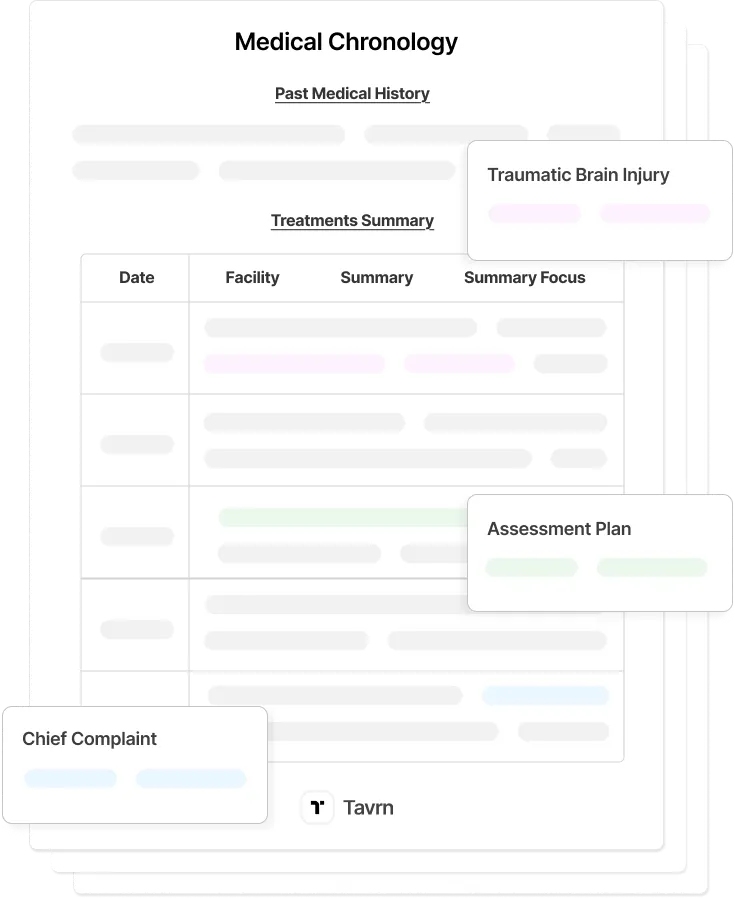
After records leave any of these systems, they still need to be organized into a usable chronology. Tavrn supports that legal-side workflow with structured chronology generation and related record-processing tools built around the materials that come out of these platforms.