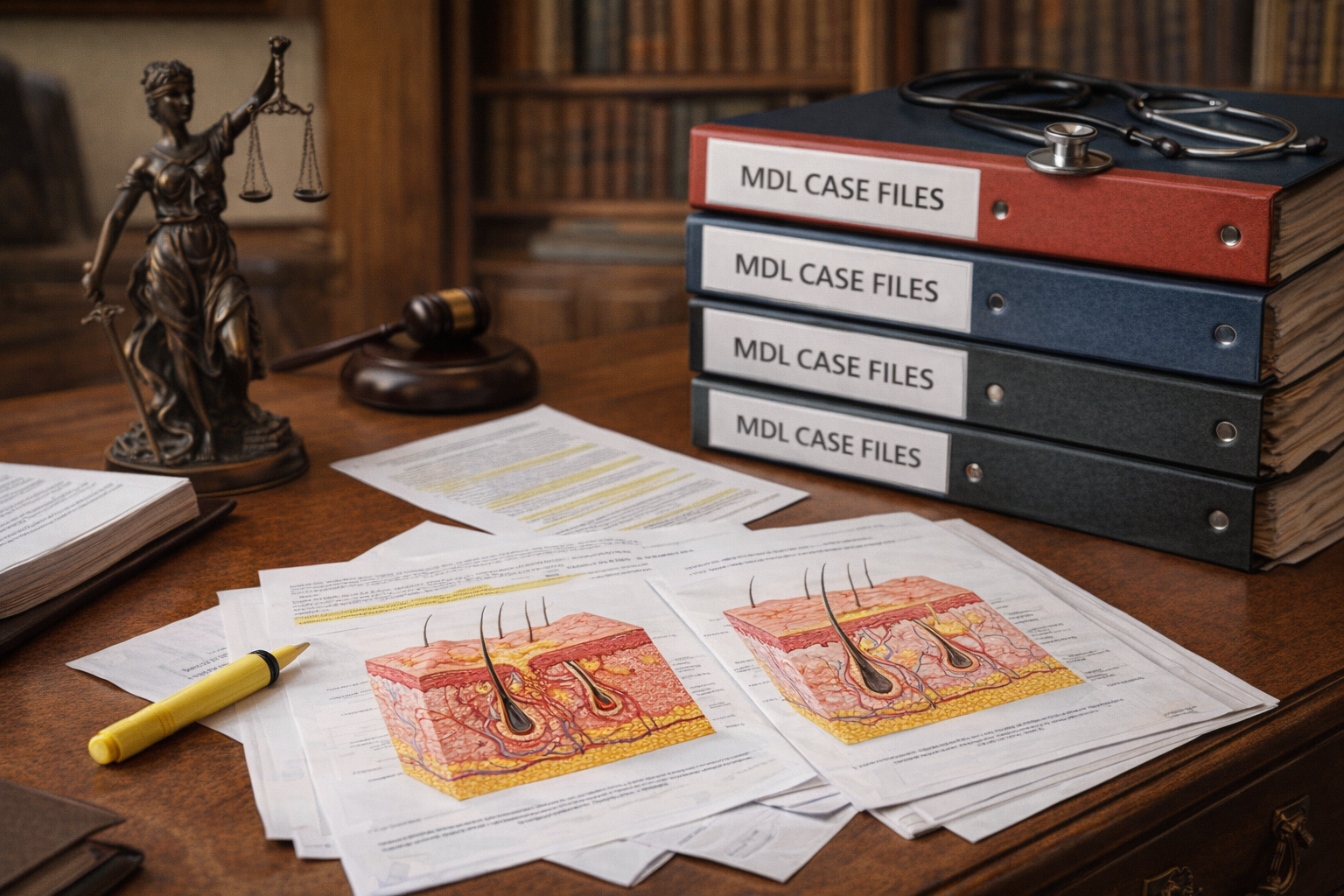
Medical records are written for the clinician who will act on them next, not for the attorney who will argue from them later. That gap between how records are produced and how litigation requires them to be read is where chronology errors, weakened demand letters, and deposition surprises originate.
Medical record review terminology is a practical literacy problem, not a clinical education problem. Terms that look self-explanatory in plain English can carry specialized meanings that create chronology errors, weakened demand letters, and deposition surprises. Accurate chronologies start with understanding the vocabulary inside the records.
This glossary covers clinical assessment terms, documentation integrity terms, legal-specific terms, coding and administrative vocabulary, and the clinical language most likely to cause downstream errors when common-language meaning diverges from chart meaning.
Clinical Assessment Terms in Medical Record Review
The vocabulary in physician notes, consultation reports, and discharge summaries shapes causation timelines and damage analysis. Misreading a single term can change what the record documents and how that documentation will be used in litigation.
Diagnosis, Impression, and Prognosis
Diagnosis and impression are often treated as equivalents, but records do not use them that way. A diagnosis is the clinician's documented determination of a condition, while an impression is a working interpretation based on the evidence available at that point in care. Radiology reports often use impression rather than diagnosis, and treating an impression as a confirmed finding creates an avoidable weakness.
Prognosis is the clinician's forecast of the probable course and outcome of a condition. Etiology refers to the cause or origin of a disease or condition, with definitional support from NIH NCBI. When prognosis or etiology appears in the record, the language may strengthen or weaken arguments about future damages and causation.
Additional Clinical Descriptors
- Idiopathic: A condition with no identifiable cause has been established.
- Comorbidity: One or more additional conditions present alongside a primary condition.
- Acute / Chronic: Acute refers to sudden onset or short duration; chronic refers to a long-developing or persistent condition. Both describe timeline, not severity.
- Bilateral: Affecting both sides of the body. CMS standards treat laterality as an important coding element, with many ICD-10-CM codes requiring it where applicable. A change from unilateral to bilateral findings may matter in chronology and causation analysis.
- Contraindicated: A treatment or procedure that should not be performed because of the patient's condition.
- Prophylactic: Treatment administered to prevent a condition rather than treat an existing one. Projected prophylactic costs can affect future medical expense arguments.
Documentation and Record Integrity Terms
Knowing how records are structured tells a practitioner where to look first instead of reading every page with equal attention. Each record form serves a defined purpose, and that purpose helps determine whether a chronology captures the right facts from the right source.
The SOAP Note Format
SOAP notes use the standard Subjective, Objective, Assessment, and Plan format. In litigation review, each section serves a distinct purpose:
- Subjective: Captures patient-reported symptoms in the patient's own words, anchoring the symptom timeline.
- Objective: Documents measurable clinical findings, including vital signs and physical exam results, supplying defensible clinical data.
- Assessment: Records the clinician's interpretation of the findings.
- Plan: Documents treatment decisions, referrals, and follow-up instructions.
A progress note records a single clinical encounter and shows interval change over time, making it central to whether a patient improved, remained stable, or worsened.
Record Types and Their Litigation Function
The chief complaint is the patient's stated reason for seeking care, typically documented in the patient's own words. That language anchors the earliest point of the symptom timeline.
Discharge summaries and operative reports serve different functions. A discharge summary is generated at the end of a hospital stay and summarizes diagnoses, treatments, and follow-up instructions. An operative report is a detailed account of a surgical procedure, including findings, technique, and complications, and often becomes key evidence in surgical malpractice and informed consent disputes.
Standard of Care, POA, and the Attending Physician
Present on Admission, or POA, indicates whether a condition existed at the time of hospital admission. Standard of care describes the degree of care a reasonably competent medical professional in the same specialty would provide under similar circumstances, with Cornell LII supplying the benchmark definition used in malpractice and negligence litigation. The attending physician is the physician with primary responsibility for the patient's care, which matters when identifying who bore the duty of care at a given stage of treatment.
Legal-Specific Terms in Medical Record Review
Some terms matter because of what they do in litigation rather than in treatment. They connect clinical documentation to insurer evaluation, damages framing, and expert review.
Causation, Pre-Existing Conditions, and Aggravation
A pre-existing condition is a medical condition documented before the incident at issue. In litigation, the central question is usually not whether the condition existed, but whether the incident aggravated it beyond its prior state. Locating baseline documentation and preserving that distinction determines how effectively a demand file supports the argument.
Aggravation of condition means a worsening of a pre-existing condition caused by a subsequent incident. Causation is the determination that a specific action or event produced a specific injury or condition. In practice, both depend on precise documentation of what existed before the event, what appeared at presentation, and what developed afterward.
Medical necessity is a determination used in both clinical and coverage contexts to indicate that a treatment or service is appropriate for the patient's condition.
Damages Terms and Independent Review
Maximum Medical Improvement, or MMI, is the point at which a patient's condition is unlikely to improve further with additional treatment. In workers' compensation contexts, Minnesota DLI defines MMI as a threshold used in claim evaluation, including permanent impairment assessment. Permanent impairment refers to a lasting functional deficit assessed after MMI is reached.
Life care plans project future medical needs and associated costs, translating clinical prognosis into economic damages evidence. An Independent Medical Examination, or IME, is conducted by a physician not involved in treatment, typically at the request of an insurer or opposing party. IME findings often conflict with treating-physician records,so understanding both sets of documentation is essential to structured record review.
Coding and Administrative Terms Legal Teams Encounter
Billing and administrative vocabulary appears throughout medical records and often creates confusion because it does not map neatly onto clinical narrative. These terms relate more to billing accuracy, coverage disputes, and record authentication than to direct causation analysis.
ICD-10-CM is the International Classification of Diseases, 10th Revision, Clinical Modification, the standardized code set used to document diagnoses in clinical and billing records. Unlike a treating physician's narrative notes, which describe a condition in clinical language, ICD-10 codes are assigned according to specific documentation and billing requirements governed by CMS coding guidelines. A code in the record may carry more or less specificity than the physician's written diagnosis, or reflect a billing adjustment rather than a clinical revision. That discrepancy does not indicate an error on its own, but it does warrant comparison against the narrative before drawing causation or damage conclusions.
CPT codes, maintained by the AMA, describe medical procedures and services performed. In general terms, CPT codes document what was done, while ICD-10 codes document why. Utilization review, or UR, evaluates the medical necessity of treatments for insurance coverage purposes and may occur prospectively, concurrently, or retrospectively.
Clinical Documentation Improvement, or CDI, is a process meant to ensure documentation reflects the severity and complexity of a patient's condition. CDI queries can result in amended records, which may raise authenticity questions in litigation. Protected Health Information, or PHI, is individually identifiable health information subject to HIPAA protections, and HHS HIPAA governs how PHI may be used and disclosed in judicial proceedings.
Clinical Terms That Mean Something Different Than They Read
This category produces many chronology errors because the words look familiar outside medicine. The risk is not obscure terminology. The risk is ordinary English being used in a specialized clinical way.
Acute means sudden onset or short duration, not severe. Impression denotes a working clinical interpretation, not a confirmed diagnosis. Those distinctions matter because a timeline built on common-language assumptions can overstate what the record proves.
- Unremarkable: Means normal; no abnormal findings detected. It does not mean insignificant or unimportant. An unremarkable MRI result documents that the structures imaged showed no abnormality, not that the exam lacked clinical importance.
- Stable: In documentation, stable is defined in relation to treatment goals, not simply as unchanged. The AMA E/M guidelines define stable in relation to treatment goals; a patient not at treatment goal is not stable even if the condition has not changed. In chronology work, stable should not be recorded as evidence of recovery or minor injury.
- Benign: Means not cancerous, not harmless. The National Cancer Institute notes that benign tumors can sometimes be large and can cause serious symptoms or be life-threatening. Describing a benign finding as not serious mischaracterizes the record.
- Within Normal Limits (WNL): Indicates that a specific measured value falls within the reference interval for that test. The point reflected in PMC is that WNL applies to a measurement within a reference range, so recording "patient had normal exam" from a WNL notation can overstate what was tested.
- Non-Contributory: Means the information in that section did not contribute to explaining the current presenting complaint at that encounter. Yale is cited for the point that this is relational shorthand, not a legal determination of relevance. A past medical history marked non-contributory may still matter in litigation involving pre-existing conditions or apportionment.
A Working Glossary Built for the File, Not the Shelf
This glossary organizes medical record review terms by how they function in the record and in litigation, with the most common clinical language traps identified explicitly. Distinctions such as impression versus diagnosis, stable versus improving, and benign versus harmless often determine whether chronology work reflects the chart accurately. Understanding those distinctions is a prerequisite for chronology work that survives medical errors that surface later in discovery.
Medical record review requires vocabulary fluency and a workflow that surfaces the right terms from the right documents before chrono tools are used. Tavrn supports that work through tools built around medical record analysis and chronology development, with related support reflected in medical analysis.
.png)

.png)
.png)