Last Updated: September 29, 2026
Requesting medical records in New Jersey follows the same medical records request process used nationwide, starting with a signed authorization sent to the provider or facility holding the record. New Jersey caps the charge for a copy of a patient's medical record at $1 per page or $50 for the entire record, whichever is less, when the request comes from the patient or a representative authorized by law (Public Law (P.L.) 2022, c.114).
The sections below cover governing authorities, retention, fees, response timing, authorization, and practice-area exceptions.
What Statutes Govern Medical Records Requests in New Jersey
New Jersey regulates records access on two tracks: Board of Medical Examiners (BME) licensees and hospitals. On each track, a statute fixes fee caps and the response deadline while a regulation sets the licensing standard; the statute controls where they conflict. Both statutes were last amended by P.L. 2022, c.114, approved September 22, 2022.
- BME licensees, including physicians and physician practices, along with most outpatient specialists: N.J.S.A. 45:9-22.27.
- BME licensing standard: N.J.A.C. 13:35-6.5.
- Hospitals: N.J.S.A. 26:2H-5n.
- Hospital licensing standard: N.J.A.C. 8:43G-15.3.
The HIPAA access rule at 45 C.F.R. § 164.524 applies alongside these state rules. Under 45 C.F.R. § 160.203(b), a state privacy law more stringent than HIPAA is not preempted, so New Jersey's fee caps apply alongside the federal access rule.
A physician chart older than 7 years may lawfully be gone, while hospital retention under N.J.S.A. 26:8-5 and the health maintenance organization (HMO) rule at N.J.A.C. 11:24-10.5 runs longer.
Drawn from N.J.A.C. 13:35-6.5, N.J.S.A. 26:8-5, N.J.A.C. 11:24-10.5, and the State Board of Medical Examiners Patient Records guidance, as of September 2026.
Confirming which window applies before assuming a chart is gone can preserve a retrieval that otherwise looks foreclosed, particularly within the age-23 minor extension for hospitals and HMOs.
New Jersey Fee Caps for Patient and Attorney Records Requests
New Jersey limits reproduction fees for patient-side requests, while authorized third parties remain subject to per-page pricing. The provider track sets how each limit is measured, and requester status determines the available caps and waivers.
Drawn from N.J.S.A. 45:9-22.27 and N.J.S.A. 26:2H-5n as amended by P.L. 2022, c.114, as of September 2026.
N.J.A.C. 13:35-6.5(c)(4) and the BME Patient Records handout still show the pre-amendment $100.00 cap and $10.00 under-10-page fee, and N.J.A.C. 8:43G-15.3(d) still shows the $200.00 maximum and $10.00 search fee. Pending bill S3140 would cut the hospital search fee to $10 and require electronic delivery; current law retains the $20 fee and existing rules.
Physician and BME-Licensed Provider Fees (N.J.A.C. 13:35-6.5)
N.J.A.C. 13:35-6.5 bars any copying fee in three situations:
- The licensee terminated the patient relationship under N.J.A.C. 13:35-6.22
- The record is needed for continuing care
- An illegible or non-English record needs transcription
A licensee may not withhold a record another provider needs for care over an unpaid balance.
Hospital Fees (N.J.A.C. 8:43G-15.3 and N.J.S.A. 26:2H-5n)
Beyond the reproduction cap, N.J.S.A. 26:2H-5n permits hospitals to charge actual delivery costs plus sales tax, and one $20.00 search fee applies per request regardless of admissions searched. N.J.A.C. 8:43G-15.3(d)(3) requires an inability-to-pay policy assuring full or certified copies rather than an abstract, and the statute includes hospital certification and X-ray charges that N.J.A.C. 8:43G-15.3(d)(2)(ii) omits.
An authorized third party pays $1.00 per page, while a qualifying representative gets the $50 cap. N.J.S.A. 26:2H-5n(e) and N.J.S.A. 45:9-22.27(k) define "legally authorized representative" to include:
- A spouse, domestic partner, or civil union partner
- Immediate next of kin or legal guardian
- An automobile insurer or workers' compensation carrier
- The patient's attorney
An unrelated requester holding only an authorization pays the third-party rate, not the $50 cap.
HIPAA's flat $6.50 charge for electronic copies applies only to a patient's own request; the court-order notice from HHS confirms the § 164.524(c)(4) fee limitation "does not apply to an individual's request to transmit records to a third party," so New Jersey's state fee caps govern attorney-directed requests. Under the Notice of Adoption for subsection (f), effective January 5, 2026, persons improperly charged the SSI/SSDI-exempt fee on or after March 1, 2020 can apply for a refund with documentation.
N.J.S.A. 26:2H-5n and N.J.S.A. 45:9-22.27(j)(4) apply the fee waivers listed above to both provider tracks, covering SSI or SSDI applicants and recipients (and their attorneys), patients at or below 250 percent of the federal poverty level, patients enrolled in a qualifying state or federal assistance program, pro bono representation, and non-profit legal services representation.
How the 30-Day Response Window Works Under New Jersey Law
N.J.A.C. 13:35-6.5(c)(1) and N.J.S.A. 45:9-22.27(a) require BME licensees to produce treatment and billing records no later than 30 days from receipt of a request, and N.J.S.A. 26:2H-5n and N.J.A.C. 8:43G-15.3 set the same outer limit for hospitals. A direct patient access request to a hospital instead follows § 164.524 timing.
45 C.F.R. § 164.524(b)(2) allows 30 days plus one 30-day extension with written notice inside the first 30 days. Because N.J.S.A. 26:2H-5n applies HIPAA timing only to a patient's direct access request, an attorney request made under a HIPAA authorization stays under the state 30-day rule.
Complaints go to the state regulator for the record holder, with a separate federal channel for HIPAA access violations:
- Hospitals: the Department of Health health facility complaint portal or 24-hour hotline, 800-792-9770.
- BME licensees: the Division of Consumer Affairs Board complaint form, under "Administrative/Recordkeeping" or "Fees/Billing."
- Federal: the federal filing channel, within 180 days of the act or omission.
State channels address the 30-day rule and fee caps; OCR reviews HIPAA access violations.
What Makes an Authorization Form Compliant in New Jersey
A compliant authorization carries HIPAA's authorization elements under 45 C.F.R. § 164.508. Effective April 1, 2027, P.L. 2026, c.4 will separately bar health care facilities from collecting or disclosing a patient's immigration status, citizenship status, place of birth, Social Security number, or individual taxpayer identification number without written consent (specifying the information shared, its purpose, its voluntary nature, the right to revoke, and the recipient) or an exception for care delivery, billing, or a legal requirement. An authorization commonly includes:
- Patient identification: legal name and date of birth, plus any aliases
- Specific provider or facility named instead of "any and all providers"
- Date range
- Each record category listed separately; radiology images are released only when specifically requested
- Recipient: attorney's name, firm, address, and stated legal relationship
- Dated patient signature
- Expiration and right-to-revoke language
The signed authorization goes to the record holder's health information management (HIM) department through a patient portal or online release-of-information form. Mail and fax are also available.
A representative other than the patient attaches proof of legal authority, such as a health care power of attorney or guardianship judgment, because a HIPAA authorization alone does not establish it.
Practice-Area Exceptions That Change the Request Process
Three practice areas alter the standard request process: substance use disorder treatment records, workers' compensation records, and records involving custodial minors.
Substance Use Disorder Treatment Records
Federally assisted substance use disorder (SUD) programs operate under 42 C.F.R. Part 2 and require a consent under 42 C.F.R. § 2.31 describing the information "in a specific and meaningful fashion," identifying the recipient by name or class, and carrying the redisclosure notice; a general treatment, payment, and health care operations designation is also permitted.
A separate consent applies to SUD counseling notes. A court order under 42 C.F.R. § 2.64 requires notice to the patient and record holder and a good-cause finding; a civil litigation demand alone is insufficient.
The 2024 Final Rule's compliance date of February 16, 2026 took effect as scheduled, and OCR began accepting Part 2 complaints that day. A pending Part 2 FAQ entered OIRA review on August 24, 2026; the standing consent and court-order requirements remain in effect pending its release.
Workers' Compensation Records
Workers' compensation records sit on a separate procedural track through the NJ Division of Workers' Compensation. N.J.A.C. 8:43G-15.3(d)(5)(vi) limits a carrier to the portion of the record relevant to the specific work-related incident.
New Jersey's form WC-147 lets a request specify particular claim petitions, all cases for the injured worker, or all cases except those listed. Records the employer furnishes under N.J.A.C. 12:235-3.8(c) can reduce duplicative provider requests and fees.
Minors' Records and Custodial Authority
Under N.J.A.C. 13:35-6.5(a), a parent or guardian with sole or joint custody is the minor's authorized representative for BME-held records, and providers may ask for custody documentation; the same subsection removes that status for pregnancy, sexually transmitted disease, or substance use disorder ("substance abuse") care, requiring the minor's own authorization instead. Affirmative consent authority for those conditions sits outside N.J.A.C. 13:35-6.5, under N.J.S.A. 9:17A-1 for pregnancy-related care and N.J.S.A. 9:17A-4 for sexually transmitted infection and substance use disorder treatment.
Pending Assembly bill A863 and pending Senate bill S1979 would require parental access without the minor's authorization if enacted. Current law continues to require the minor's authorization for that access.
Statutory Compliance as the Foundation for Case Momentum
New Jersey's fee caps, retention periods, and 30-day response deadline are set by statute and regulation and vary by provider type, requester status, and record category, with the state schedule and HIPAA's timing and fee rules applying together depending on who is making the request.
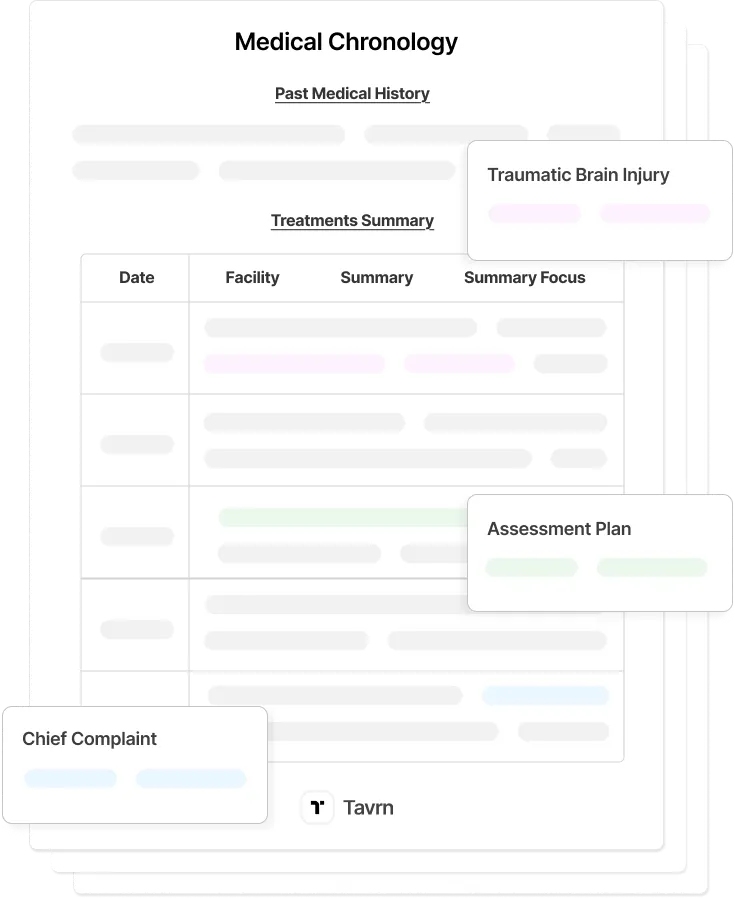
Medical record retrieval and defensible chronologies form part of the documentation that supports personal injury and workers' compensation case preparation.