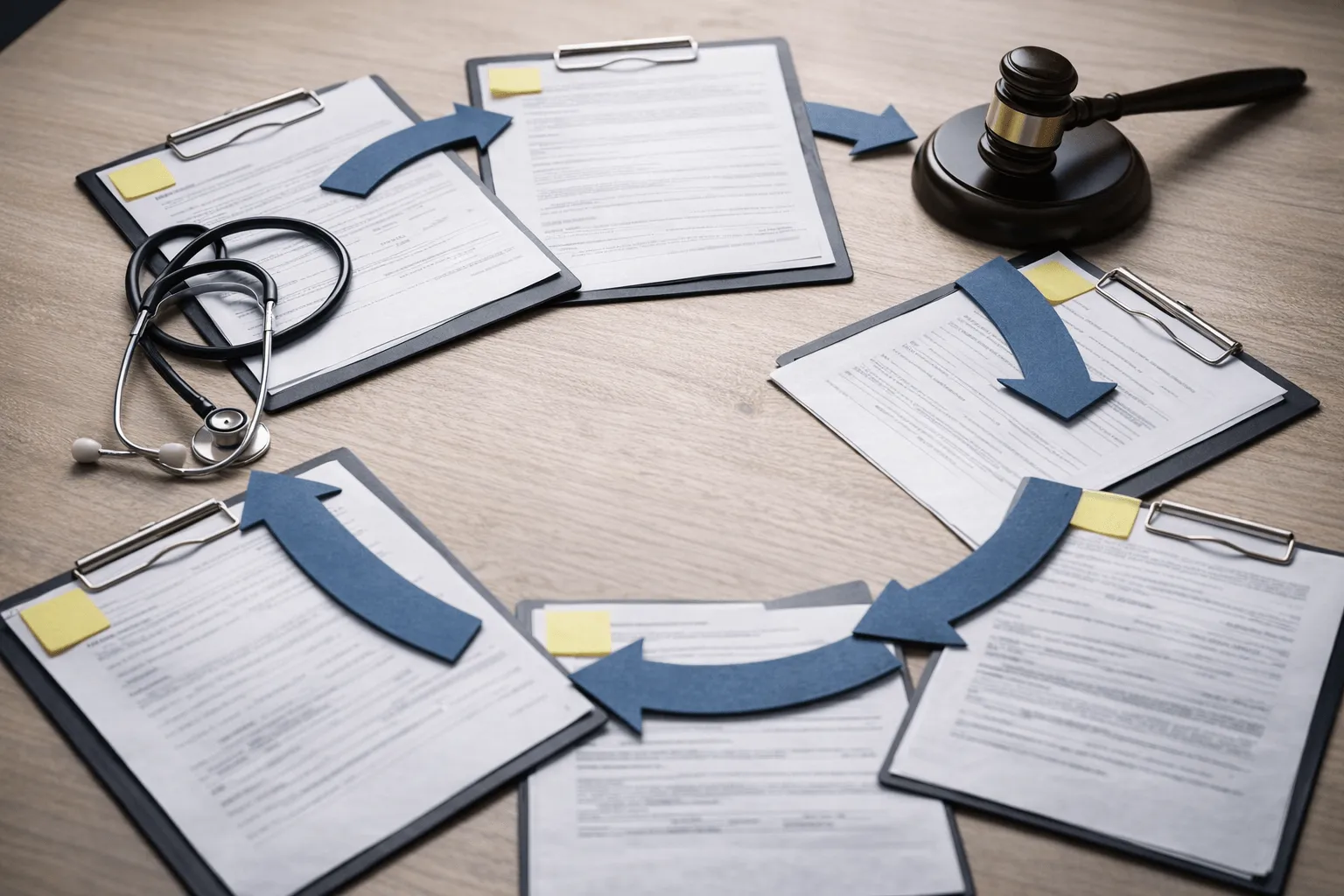
.png)
Both Tavrn and Eve Legal turn medical records into source-linked chronologies and demand drafts for plaintiff firms, and both publish policies limiting how client data trains AI models. They diverge at the starting line. Eve's medical workflow begins once a firm uploads records it already holds, while Tavrn's begins by getting those records out of providers.
Eve sells EveOS, described on its homepage as "the AI operating system for plaintiff law," built around intake, drafting agents, and nightly case review. Tavrn covers records retrieval, chronologies, and demand letters as a discrete workflow that supplies a firm's broader stack.
Firms mapping records automation will recognize the split. This comparison covers where each platform enters the file, what feeds the chronology, who reviews the output, and what stays on the firm's plate.
Table of Contents
- Tavrn vs. Eve Legal: Key Differences at a Glance
- Where Each Platform Picks Up the Case
- What the Chronology Is Built From
- Who Reviews the Work Before an Attorney Relies on It
- What the Firm Still Owns Either Way
- Which Platform Fits Your Firm
Tavrn vs. Eve Legal: Key Differences at a Glance
Both platforms serve plaintiff firms with AI-built medical chronologies, page-level source citations, demand drafting, AES-256 encryption at rest, and published limits on model training; the table shows where that overlap ends.
Eve Legal details above are as published on eve.legal, including its Medical Overview, security, privacy policy, and Master Service Agreement pages, accessed September 2026.
The rows sort into one question. Eve begins with files already in the matter; Tavrn begins with the request that produces them. That boundary decides whose payroll absorbs the review pass and who works the provider when a chronology reveals a hole in the file.
Where Each Platform Picks Up the Case
Eve enters the file after the records are in hand; Tavrn enters while the request still needs to go out. Eve's Medical Overview page is explicit about its starting point: "Upload the records and bills" is step one, and Eve Atlas then reads incoming records, bills, call transcripts, and CRM notes and structures them as they arrive. Its drafting page adds that Eve "only pulls from the documents you upload and your Central Library, never from the open internet." That design grounds output in uploaded material and sets the documented starting point for its medical work.
Tavrn starts at the request stage, with AI voice agents contacting providers the same day a request is placed. Per its retrieval product page, "a single request" triggers agentic workflows that "retrieve records from thousands of providers nationwide, track request status in real time, and deliver complete, organized records directly to your case file." Authorization forms are generated, providers are contacted, and follow-ups are handled automatically, and records arrive already tagged and filed to the right matter.
For a paralegal, the difference shows up on the stalled request. A hospital system leaves one sitting unanswered. On the upload-first model, there is no new record to structure until someone obtains it. On the retrieval-first model, the pursuit is already running: Tavrn's agents hold providers to their statutory response window and catch the common defects that stall a request before it goes out: a wrong form, a missing signature, a mismatched signature, or a wet-ink requirement not met. That is where turnaround gains tend to come from.
What the Chronology Is Built From
Eve's chronology is built from what the firm uploads; Tavrn's can be built from records the platform retrieved itself. Eve's analysis of an uploaded set processes case files up to 40,000 pages per its medical malpractice page, applies OCR to scanned, faxed, and handwritten documents including chiropractor records, hyperlinks every data point to its source page, and cross-references records against bills to flag "providers mentioned in treatment notes without records on file." Eve does not state that flagging a missing provider initiates retrieval.
Tavrn's chronology arrives in under three hours, most in one, covering diagnoses, treatments, procedures, gaps in care, and flags for pre-existing conditions, each linked to its original source page. Martay Law Office, a high-volume Illinois workers' compensation firm, reports in Tavrn's published case study that it handled records exceeding 22,000 pages in minutes and grew case filings almost 65% year over year.
The consequence is what happens to a detected gap. On both platforms, the gap surfaces; only one of them also closes it.
Who Reviews the Work Before an Attorney Relies on It
Both models put a human between the AI and the attorney, but they place that human on different payrolls. Eve's drafting page calls its outputs "a strong first draft, not a final filing," and its agents page states that no work product reaches a client or opposing counsel without a human in the loop. Those statements establish firm-side approval before use without describing a separate chronology review service.
Tavrn puts a reviewer inside delivery. Its chronology page states that "Each summary is AI-generated and then reviewed by a specialist for accuracy and consistency," so the chronology a paralegal opens has already had a human pass.
For a firm costing this out, the question is not whether review happens but who performs it and whether that time sits inside the vendor's price or the firm's week.
What the Firm Still Owns Either Way
What remains on the firm's plate depends on whether the workflow starts before or after record acquisition. Eve's downstream range is broad: complaints, discovery responses, motions, and mediation briefs, and its drafting page notes that two completed examples are enough for Eve to learn a document type in a firm's style. Its medical workflow still begins with an upload.
Tavrn handles acquisition ahead of the chronology and the demand, and the known tradeoffs of automated drafting apply to whatever tool the firm uses downstream. As a discrete layer, Tavrn can feed organized records into a firm's chosen workflows without one vendor owning the broader document stack.
The operational effect is less provider-chase time on the firm's payroll. Paul LLP reports in Tavrn's published case study that paralegal time on record requests fell from multiple full days per week to roughly one to two hours, across matters sourcing records from hundreds of facilities.
Which Platform Fits Your Firm
Choose Tavrn when cases stall upstream: requests sitting unanswered with providers, paralegals working phone trees, chronologies and demands waiting on incomplete record sets. Retrieval runs the pursuit automatically, catches the common defects that stall a request before it goes out, and holds every provider to its statutory response window. Chronologies and demand letters build from the same structured record set, and Tavrn connects to Clio, Litify, Neos, SmartAdvocate, Smokeball, and CasePeer for firms running their own stack.
Consider Eve when records already reach the firm reliably, and the constraint is everything after that. Eve's breadth is real: discovery responses, motions, briefs, nightly case review, and intake answered around the clock in more than 28 languages. For a firm whose records arrive on time, that range is the stronger argument.
So the question is what a stalled case is waiting on today: a draft, or a record.
Close the Records Gap First
Tavrn is built to get medical records in on time, which is the step manual handling tends to absorb. Agents hold providers to their statutory window and catch the request-level defects that cause a bounce, so records arrive complete instead of stalling on a form that quietly needed a signature.
Bigos Law adopted the full pipeline and reports in Tavrn's published case study roughly 10x faster productivity and case closing, including a case involving three minors where negotiations concluded in one week against typical timelines of up to six months.
To learn more, book a demo.
.png)