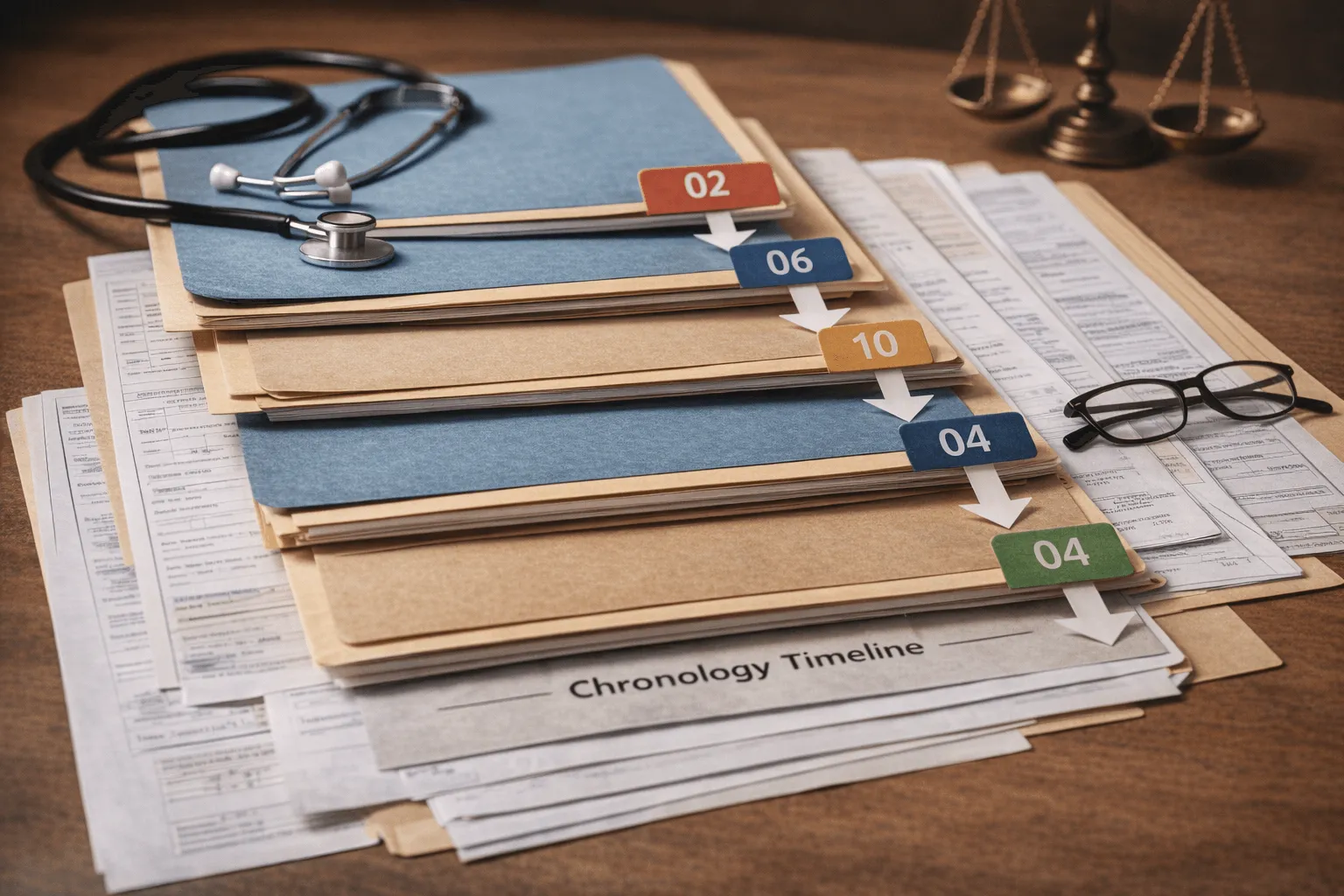
Medical records chronology templates are easy to find; defensibility standards are not. The gap between a chronology that organizes records and one that holds up under litigation scrutiny is where case risk concentrates.
A medical records chronology template structures the extraction and sequencing of clinical data from source records into a format that supports case evaluation, expert review, and settlement positioning. When built to evidentiary standards, it becomes a litigation instrument rather than an administrative convenience.
This guide provides on-page templates differentiated by case type, a step-by-step process for building defensible chronologies, and measurable quality benchmarks that separate court-ready work product from medical chronology reports that merely look organized.
Core Elements and Quality Standards for a Defensible Medical Chronology
Defensibility is not a formatting choice. It is the product of evidentiary compliance: ensuring that every chronology entry supports authentication and admissibility of underlying medical records under FRE 803(6) and Rule 901. No professional organization, including NALA or NFPA, publishes mandatory chronology field standards, which means defensibility emerges from professional judgment applying authentication principles rather than template compliance.
Every entry in a court-ready chronology must include these authentication-driven baseline fields:
- Date of service: exact date and time of each encounter
- Provider name and credentials: matching custodian certification details
- Facility name and location: corresponding to authentication affidavit
- Record/visit type: progress note, operative report, imaging study, lab result
- Diagnosis: ICD codes or clinical diagnoses preserved verbatim from source
- Treatment and procedures: exact medical terminology as documented
- Medications: drug name, dosage, route, frequency
- Bates or page reference: precise citation linking every entry to its authenticated source document
Three elements elevate a template from functional to defensible:
- Source traceability: Every entry must connect through a documented chain from the entry to a Bates number, to an authenticated source document, to a custodian affidavit. ACEDS professional guidance confirms this connection is essential for document authenticity.
- Record completeness documentation: A reconciliation log tracking all records received, Bates assignments, identified gaps, and retrieval attempts.
- Treatment gap notation: Explicit date-range documentation of periods with no clinical activity, distinguishing between "no treatment sought" and "records not yet obtained."
These standards, combined with terminology preservation that avoids paraphrasing clinical language, form a measurable quality framework across case types.
Medical Records Chronology Template by Case Type
Field requirements shift by case type because the legal elements differ. The templates below reflect these distinctions.
Personal Injury Chronology Template
Personal injury cases require fields that tie injuries to the incident and track functional impact over time, including causation indicators, functional limitations, and treatment continuity.
Causation notes capture provider language linking injuries to the incident; functional limitations document restrictions at each encounter. Treatment gaps exceeding 30 days receive explicit notation with retrieval status.
Medical Malpractice Chronology Template
Medical malpractice chronologies must support standard-of-care analysis without inserting legal conclusions. Dedicated fields track informed consent documentation, deviation indicators, and the precise temporal sequence critical to surgical complication cases.
Deviation indicators use neutral language and flag entries for attorney or expert review without drawing conclusions, consistent with AHIMA standards requiring objective clinical language.
Workers' Compensation Chronology Template
Workers' compensation chronologies add employment nexus fields, work restriction tracking, and regulatory milestones including MMI determination and impairment ratings. The California DWC and New York WCB Impairment Guidelines establish the documentation requirements reflected here.
Employment nexus fields document injury mechanism, work activity, and witness information, establishing the "arising out of and in the course of employment" standard. RTW status tracks across five categories: full duty, modified duty, partial RTW, temporary alternative duty, and not released.
Mass Tort / MDL Chronology Addendum
Mass tort and MDL chronologies often fail for reasons unrelated to clinical complexity. The operational risk is field inconsistency across thousands of claimants: different provider naming conventions, partial record sets, overlapping insurer records, and repeated diagnostic packets that obscure true first-occurrence dates.
A defensible approach uses a base clinical chronology plus an addendum layer that standardizes exposure, product use, and key eligibility facts without overwriting clinical language.
In high-volume dockets, addendum quality controls typically include: (1) a standardized provider naming table (to prevent duplicate “new provider” entries), (2) a rule for first-mention tracking (first exposure mention, first diagnosis mention, first causation statement), and (3) a separation between claimant-reported facts and clinically documented facts, each with its own citation discipline.
Building a Defensible Medical Chronology Step by Step
A defensible chronology follows a six-stage workflow grounded in NALA Model Standards, which require accuracy, verification protocols, and systematic quality assurance. The goal is an auditable build process where completeness checks, citations, and reviews are documented at each stage rather than reconstructed after the fact.
- Verify record completeness before extraction begins. Build a master index listing every provider, date range requested, authorization date, receipt status, and page count. Flag missing records explicitly. Extraction from an incomplete record set wastes time and produces unreliable work product.
- Organize, deduplicate, and Bates-number source records. Sort records chronologically by service date, identify and remove true duplicates while preserving legitimate same-day encounters, and apply sequential Bates numbering in a consistent format (e.g., SMITH-MED-000001). Create a master index linking Bates ranges to source providers, as ACEDS confirms that gapped numbering can undermine document authenticity.
In matters with multi-facility encounters (EMS → ER → inpatient), normalize time conventions before sequencing. Use 24-hour time, preserve documented time zones when present, and distinguish “order time,” “collection time,” and “result time” for labs and imaging.
- Extract entries with terminology preservation and real-time source referencing. Copy medical terminology exactly as documented. Do not paraphrase, translate to lay language, or correct apparent provider errors. Use direct quotation marks for exact clinical language. Every entry receives a Bates citation at the time of extraction, not retroactively.
High-risk extraction points that warrant deliberate handling include:
Radiology addenda and amended results: log both the initial read and the amended read with separate timestamps.
Medication changes: capture stop/start language (e.g., “discontinue,” “hold,” “resume”) rather than inferring adherence.
Procedure timing: preserve documented “incision,” “anesthesia start,” and “PACU” times when material to the timeline.
- Cross-reference across providers for inconsistencies and gaps. Compare encounter dates, diagnoses, medication lists, and test results across provider records. Document discrepancies with neutral language and full citations to both sources. Do not resolve conflicts; flag them for attorney or expert review.
- Execute multi-stage quality review. Self-review first: verify citations against source documents, confirm chronological accuracy, and check for completeness. Peer review second: a separate reviewer spot-checks entries against originals, examines timeline logic, and audits discrepancy flags. Each review stage receives date-stamped documentation with reviewer identification.
- Prepare the attorney handoff package. Deliver the final chronology alongside the master provider index, missing records log, discrepancy log, key events summary, and deduplication log. Brief the attorney on completeness status, timeline gaps, and items requiring legal analysis.
Scaling Medical Chronology Workflows Beyond Manual Templates
Template quality is not the structural bottleneck in medical chronology production. Complex cases involving fragmented provider networks require significant paralegal hours for manual extraction alone. Across an active caseload, the throughput ceiling becomes a capacity constraint that no template redesign can solve.
Automation fits at the extraction and organization layer: converting source records into structured chronology entries with Bates-linked citations. The paralegal role shifts from data extraction to clinical interpretation, cross-provider analysis, and quality review, which is where experienced judgment adds irreplaceable value.
When evaluating chronology automation, three criteria determine whether the output meets the defensibility standards outlined in this guide:
- Source-page linking: Does every extracted entry include a verifiable citation to the original Bates-numbered source document?
- Extraction accuracy: Does the system preserve medical terminology verbatim, or does it paraphrase and risk altering clinical meaning?
- Downstream integration: Can the output feed directly into case workflows without reformatting or manual correction?
Automation that cannot meet authentication-driven field requirements, terminology preservation standards, and source traceability protocols produces chronologies that are organized but not defensible.
From Template Structure to Litigation Readiness
Templates provide structure; defensibility standards determine whether that structure holds under scrutiny. Case-type-specific fields, source traceability through Bates-linked citations, terminology preservation, and multi-stage quality review separate usable chronologies from those that create litigation risk.
Tavrn builds AI-powered chronologies with source-page linking, verbatim extraction, and output designed for the same defensibility framework covered in this guide, preserving paralegal expertise for review and clinical interpretation rather than manual data entry.