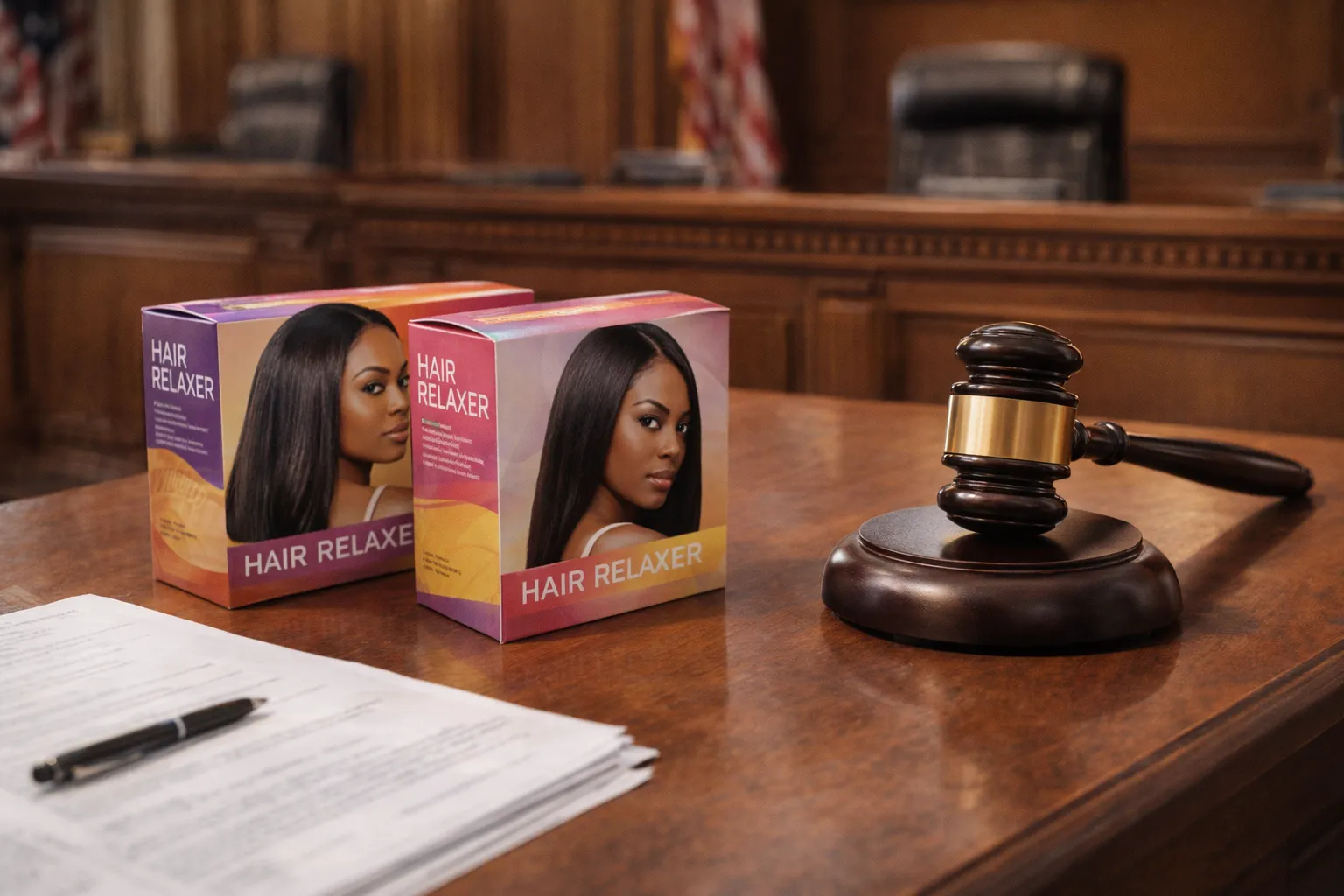
The Judicial Panel on Multidistrict Litigation transferred In re Hair Relaxer Marketing, Sales Practices, and Products Liability Litigation (2023) to Judge Mary M. Rowland in the Northern District of Illinois on February 6, 2023.
The named defendants include L'Oréal USA, Revlon, Strength of Nature, LLC, Namaste Laboratories, L.L.C., Advanced Beauty, Inc., Avlon Industries, Sally Beauty Supply LLC, and Wella Operations US LLC. Plaintiffs allege that chemical hair relaxer products containing endocrine-disrupting chemicals caused uterine cancer, endometrial cancer, ovarian cancer, and uterine fibroids. The October 2022 NIH Sister Study linking frequent hair straightener use to elevated risk of uterine cancer preceded the filing wave.
This article covers JPML consolidation, Judge Rowland's dispositive rulings, Revlon's bankruptcy carve-out, and Daubert posture.
How MDL 3060 Took Shape in the Northern District
The NIH published its Sister Study findings on October 17, 2022. Within weeks, plaintiffs filed actions across multiple federal districts, and a motion to centralize under 28 U.S.C. § 1407 followed in November 2022.
At filing, the motion encompassed 9 actions in 4 districts. By the Panel hearing, the litigation had grown to 53 federal actions across 19 districts. L'Oréal USA, Dabur International/Namaste Laboratories, Strength of Nature, and House of Cheatham opposed centralization, arguing the actions involved disparate products with no single EDC common to all formulations. They proposed the Southern District of New York as an alternative forum.
The JPML identified three common factual questions:
- Whether exposure to phthalates or other EDCs causes injury to the reproductive system
- Whether and when defendants knew or should have known of the alleged risks posed by hair relaxer products
- Whether defendants engaged in adequate testing and post-market surveillance
The Panel rejected splitting the litigation into defendant-specific MDLs, finding plaintiffs' indivisible claims made separate transfers unworkable. Direct-filing procedures were later established, and Lexecon waiver questions tied to that mechanism are reflected in docket activity. As of May 1, 2026, the JPML statistical report shows 11,526 pending federal actions, with related proceedings also active in Illinois state courts, Pennsylvania, Georgia, and New York.
Studies Underpinning the Hair Relaxer Claims
General causation is the litigation's central battleground. The epidemiological record will determine whether bellwether trials proceed on the 2027 track.
The primary study is Chang et al. (2022), published in the Journal of the National Cancer Institute. Researchers followed 33,947 Sister Study participants (mean follow-up: 10.9 years), identifying 378 incident uterine cancer cases. Ever use of hair straightening products in the prior 12 months carried a hazard ratio of 1.80 (95% CI: 1.12 to 2.88).
Frequent use, defined as more than four times per year, carried a hazard ratio of 2.55 (95% CI: 1.46 to 4.45; P-trend = .002). Approximately 60% of participants who reported recent straightener use self-identified as Black women, despite Black women comprising only 7.4% of the full cohort.
Earlier epidemiological work, including the Black Women's Health Study on uterine leiomyomata, had identified associations between chemical hair product use and reproductive conditions, though the Chang et al. findings on uterine cancer drove the litigation wave.
The chemical pathway alleged in the MDL centers on:
- Parabens, including methylparaben and butylparaben
- Bisphenol A
- Phthalates, including DEHP
- Heavy metals, including lead and cadmium
- Formaldehyde and formaldehyde-releasing agents
Scalp absorption may be exacerbated by burns and lesions caused by straightener application. The FDA's proposed rulemaking on formaldehyde and formaldehyde-releasing chemicals in hair smoothing and straightening products has not advanced to a published proposed rule and remains pending as of May 2026.
Judge Rowland's Rulings on Dispositive Motions
Two opinions, issued November 2023 and September 2024, defined which claims proceed to trial.
The Master Long Form Complaint (ECF 106, filed May 15, 2023) contained 15 causes of action across strict liability, negligence, warranty, fraud, and consumer protection. Defendants moved to dismiss on four grounds:
- 21 U.S.C. § 379s preemption
- Rule 9(b) heightened pleading for fraud-based claims
- Personal jurisdiction
- Article III standing
Judge Rowland's November 13, 2023 ruling (ECF 291) rejected preemption at the pleading stage under the § 379s(d) product liability savings clause. The court held that preemption is an affirmative defense, citing Benson v. Fannie May Confections Brands, Inc., 944 F.3d 639 (7th Cir. 2019), and defendants had conceded the savings clause shielded product liability claims. Three fraud-based counts (Counts 2, 8, 9) and the deceptive-acts portion of Count 10 were dismissed under Rule 9(b). Twelve claims survived, including negligence, design defect, failure to warn, warranty, and punitive damages.
The September 27, 2024 class action ruling (ECF 852) granted in part and denied in part defendants' motion to dismiss the Consolidated Class Action Complaint. The court found Article III standing based on economic injuries and, for a subset of plaintiffs, increased cancer risk requiring medical monitoring. A companion ruling (ECF 854) denied the joint motion to strike class allegations and deferred Revlon's separate motion to the bankruptcy court.
In February 2025, the court denied Advanced Beauty's motion to dismiss, reinforcing the breadth of the surviving claims across the defendant group.
Revlon's Chapter 11 Reorganization and the MDL
Revlon's bankruptcy creates a distinct procedural track intersecting the MDL, as in the Talcum Powder MDL.
Revlon filed Chapter 11 on June 15, 2022, in the Southern District of New York as In re Revlon, Inc., et al. (2022), Case No. 22-10760. The general bar date was October 24, 2022. The bankruptcy court established an April 11, 2023 Hair Straightening Claim bar date, and approximately 30,000 timely proofs of claim were filed by that deadline.
The confirmed Plan (effective May 2, 2023) created a three-prong deadline structure under Article IX.A.6. Each timely claimant was required to file a complaint in MDL 3060 by the latest of three deadlines:
- September 14, 2023
- 90 days after entry of the MDL Direct Filing Order
- For claimants diagnosed after April 11, 2023, six months from the date of diagnosis
Non-compliance results in claim disallowance.
The bankruptcy court enforced these deadlines in May 2024, sustaining objections and expunging six claimants' proofs of claim for failure to file MDL complaints by September 14, 2023. Recovery for Revlon claimants is limited to Revlon's pre-petition insurance policies, and MDL orders explicitly preserve bankruptcy court requirements. As of February 2025, cases naming Revlon defendants remain held under advisement in the MDL.
Bellwether Selection and Daubert Briefing Posture
The April 1, 2026 general causation Daubert deadline is the key inflection point for the 2027 trial track. The cautionary parallel is In re Acetaminophen-ASD-ADHD Products Liability Litigation (2022) (MDL 3043): complete Daubert exclusions collapsed that MDL without any bellwether trial.
CMO 15 (March 2025) established the bellwether selection framework. Each side identified 20 proposed cases by April 30, 2025, narrowed to 32 Initial Bellwether Discovery Cases by May 9, 2025. Bellwether eligibility is restricted to uterine, endometrial, and ovarian cancer claims. In February 2026, the parties filed position papers identifying 5 to 12 cases for trial selection.
CMO 17 (April 2025) appointed Special Master Ellen K. Reisman for settlement coordination. CMO 21 (June 2025) established Science Day procedures, with presentations completed January 8, 2026. General causation expert discovery closed March 2, 2026.
The remaining calendar runs through 2027:
- April 1, 2026: General causation Daubert motions filed
- October 16, 2026: Case-specific expert discovery closes
- November 16, 2026: Summary judgment and non-general-causation Daubert motions due
- 2027: First bellwether trials anticipated
If plaintiffs' causation experts survive Daubert challenge, trials proceed. If the court excludes or substantially limits those experts under the amended Rule 702 standard, defendants gain significant leverage for summary judgment, following the pattern established in In re Acetaminophen-ASD-ADHD Products Liability Litigation.
For Plaintiff Counsel
Usage history is the central evidentiary problem. CMO 9 Plaintiff Fact Sheet compliance requires internal consistency between PFS entries and Short Form Complaint product selections, and the court has dismissed cases for non-compliance, including one dismissal with prejudice in September 2025. Key documentation elements include:
- Brand identification, product selection, application frequency, and duration of use across multiple manufacturers
- Scalp injury history, salon versus home application records, and lay witness testimony for corroboration
- Purchase records, photographs, and social media posts documenting hair care routines
For Defense Counsel
Multi-defendant exposure analysis across L'Oréal, Strength of Nature, Revlon, and Namaste portfolios requires coordinated discovery on formulation, marketing, and post-market surveillance. L'Oréal's difficulty producing documents for 88 acquired-company products, referred to Special Master Grossman in November 2024, illustrates the scope of this challenge. Daubert preparation overlaps with case-specific deposition work through October 2026.
For Legal Operations
An operations lead coordinating mass-tort intake across this inventory must track PFS submission, authorization, and CMO 10 compliance status for each claimant. Revlon bankruptcy Article IX.A.6 deadline compliance demands separate tracking for claimants subject to the three-prong filing structure. Fact-sheet enforcement drives inventory culling before trial, as in the Bard PowerPort case.
MDL 3060 Resolution Trajectory
MDL 3060 stands at the intersection of sustained case inflow, April 2026 Daubert briefing, and Special Master settlement coordination. Judge Rowland's denial of preemption and bankruptcy-coordination rulings have preserved the merits architecture. No global settlement has been announced.
The 32-case bellwether group defines the empirical record for any global resolution. The documentation burden differs from that of pharmaceutical MDLs: exposure relies on consumer behavior rather than prescription records, and lay witness development carries more weight than pharmacy databases. Clinical record workflows must account for these differences when building case inventories.
For additional context on parallel Daubert posture in mass-tort proceedings, see the Paraquat MDL update.
.png)

.png)
.png)