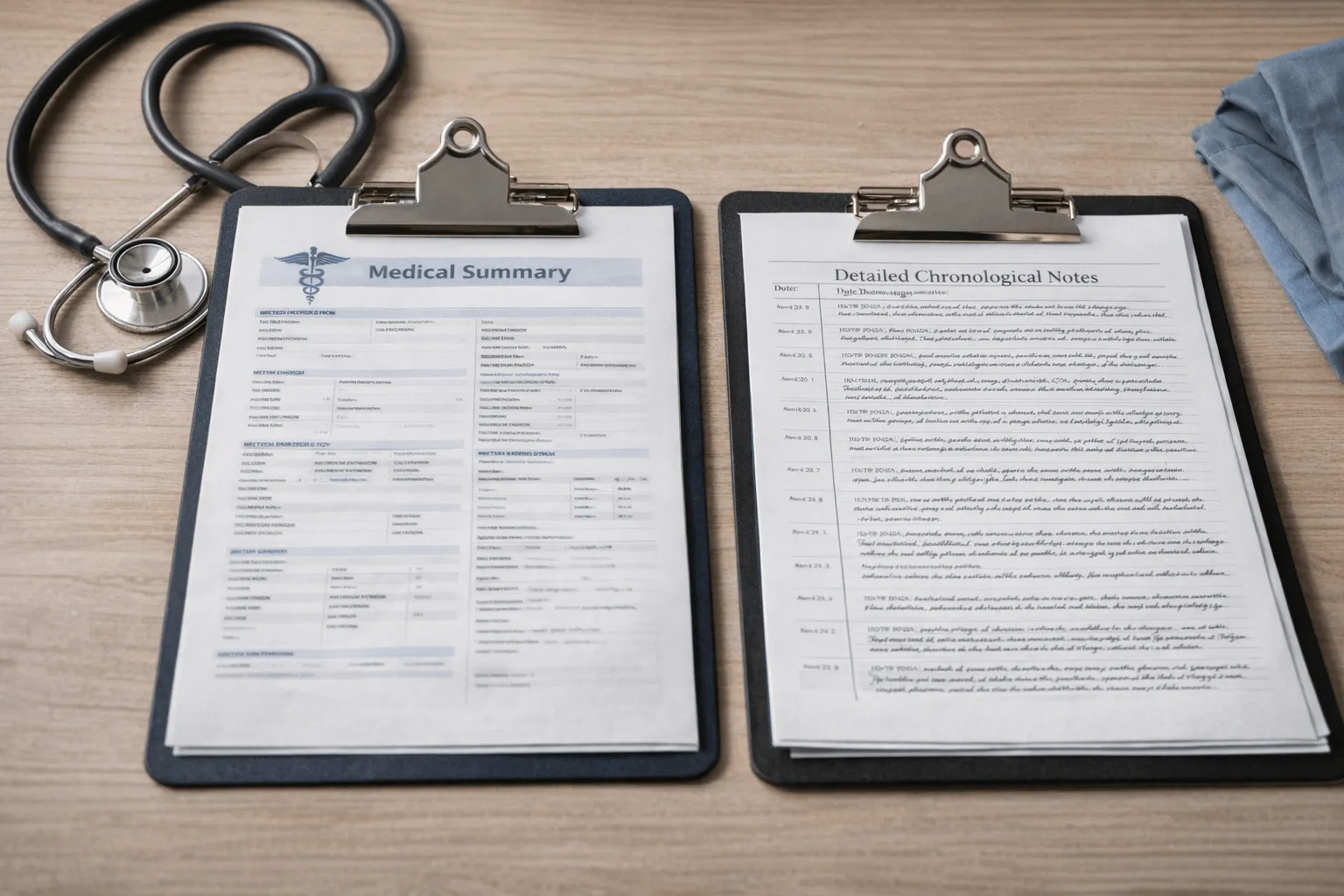
Medical records paralegals in personal injury and medical malpractice firms manage far more than record requests. The role spans regulatory compliance, clinical interpretation, multi-provider coordination, and litigation support across dozens of simultaneous cases, each with its own treatment history, provider network, and deadline pressure.
The medical records workflow operates as the connective tissue of case preparation. Every downstream task, from building medical chronologies to supporting settlement demands, depends on the completeness and organization of upstream record acquisition and analysis.
This article maps the full scope of the medical records paralegal role, traces the workflow through the PI/med-mal case lifecycle, and examines the structural bottlenecks that constrain case throughput at the paralegal level.
The Medical Records Paralegal Role Beyond the Job Description
Job descriptions rarely capture the operational breadth of the medical records paralegal position. In PI and med-mal practice, the role functions as a hybrid of compliance officer, clinical analyst, and litigation support specialist, often simultaneously across 25 to 40 active cases.
At the compliance level, paralegals manage authorization workflows governed by HIPAA's Privacy Rule, ensuring that every record request satisfies 45 CFR § 164.524 requirements for patient access and that authorizations meet state standards. HIPAA violations carry penalties ranging from $100 to $50,000 per incident, making skilled compliance management a firm-level risk function, not an administrative task.
The role also requires operational judgment in areas that rarely appear in posting language:
- Selecting the correct provider contacts (HIM vs. billing vs. ROI vendor) based on facility structure and record type
- Maintaining defensible documentation of every request and follow-up communication
- Preserving the chain of custody for late-produced or supplemental materials
- Tracking authorization expirations and resubmitting before they lapse
In contested matters, a paralegal's tracking notes often become the firm's best evidence of diligence when opposing counsel challenges record completeness or delay.
In practice, the role functions as internal quality control for clinical narratives. When an imaging report conflicts with an ED note or a physical therapy plan of care references a surgery date that does not appear elsewhere in the chart, the paralegal is often the first to flag the inconsistency. That early detection prevents downstream rework and protects attorney time during valuation, expert retention, and discovery.
Medical Records Workflow Mapped to the PI/Med-Mal Case Lifecycle
The medical records workflow follows a systematic progression through the case lifecycle. Each phase carries paralegal responsibility, and inefficiency at any stage directly constrains case throughput.
Intake and Record Identification
Intake begins with evaluating the case for medical record needs, drafting HIPAA-compliant authorizations, and establishing tracking systems across all identified providers. This phase sets the foundation; errors or omissions here cascade through every subsequent stage. Accurate provider identification at intake prevents costly re-requests and gaps that surface months later during chronology construction.
Authorization and Retrieval
Authorization and retrieval involve submitting requests to all providers, implementing follow-up protocols on 10- to 14-day cycles, documenting every provider communication, and managing incomplete responses requiring supplemental requests. Cross-referencing billing records against clinical documentation at this stage helps identify treatments that should have corresponding records but do not.
Organization and Indexing
Organization and indexing transform raw records into usable case material. This includes arranging records chronologically, applying quality control checklists, and verifying the presence of all expected record categories. Completeness verification at this stage determines whether the case file supports analysis or requires another round of retrieval.
Clinical Review and Analysis
Clinical review and analysis requires applying medical knowledge to flag standard-of-care deviations, identify documentation gaps relevant to causation, and prepare indexed binders or digital databases for attorney and expert review. For firms handling medical record review across high case volumes, this phase consumes the most paralegal time relative to its downstream impact.
Demand Support and Litigation Preparation
Demand support and litigation preparation include compiling medical evidence summaries for settlement demands, organizing records for expert witness review, preparing exhibits for discovery and depositions, and coordinating with medical experts on interpretation questions. Each of these outputs depends on the integrity of every preceding phase.
The multiplier effect is straightforward: when paralegal workflow is efficient and accurate, attorneys receive complete, organized case files that enable faster strategy decisions and stronger negotiations. When it stalls, attorney capacity stalls with it.
Record Retrieval as the Primary Workflow Bottleneck
Retrieval delays represent the single largest structural constraint on the medical records workflow. HIPAA requires covered entities to act on access requests within 30 calendar days, with a single extension of up to 30 additional days permitted under 45 CFR § 164.524(b)(2). The regulatory text explicitly prohibits multiple extensions, regardless of circumstances.
OCR enforcement records document provider delays extending well beyond the 60-day maximum, with some cases exceeding one year before records were produced. Since 2019, the OCR resolution agreements list shows the Right of Access Initiative has produced more than 50 enforcement actions.
The Right of Access Initiative's largest individual penalty reached $200,000 against Banner Health in January 2021, following complaints that patients waited months for records access.
For medical records paralegals, retrieval bottlenecks are rarely about a single late provider. The operational burden comes from uncertainty: no reliable delivery date, inconsistent production formats, and variable requirements for fees, identity verification, or portal access.
Common failure points that create repeat cycles of follow-up include:
- Requests routed to the wrong department or outsourced ROI vendor without notice
- “Partial productions” that omit radiology, PT, or provider notes referenced elsewhere
- Records produced without dates, encounter identifiers, or legible pagination
- Provider-specific forms required in addition to HIPAA authorizations
For paralegals coordinating retrieval across multiple providers per case, these delays are not isolated incidents. They are systemic.
When retrieval stalls on even one provider in a multi-provider case, completeness verification cannot proceed, chronology development is incomplete, and attorney briefing is delayed. The bottleneck propagates downstream through every phase of case preparation.
Volume and Complexity Challenges at Scale
Retrieval delays compound when multiplied across the volume and complexity that define PI/med-mal paralegal caseloads. The ABA notes that medical negligence cases often encompass years or decades of a patient's medical history, resulting in voluminous records involving multiple healthcare entities.
The scale factors are structural. A single case can involve hundreds of pages across disconnected provider systems, from structured EHR exports to handwritten clinical notes and legacy scanned documents. Multiply that across 25 to 40 active matters, each at a different lifecycle stage, and the operational picture comes into focus: simultaneous tracking, follow-up, verification, and analysis workflows running in parallel with no margin for error.
Complexity also comes from fragmentation inside a single "provider." A hospital record request may produce separate packets for:
- Facility records
- Physician group records
- Radiology reports
- Pathology results
Each carries independent release procedures. When treatment spans multiple entities in the same health system, name similarity can mask genuinely missing records until chronology construction exposes the gap.
These conditions create sustained cognitive load and operational bottlenecks across paralegal workflows. Despite advances in legal technology, the core challenge remains unchanged: managing large, fragmented medical record sets while balancing accuracy, compliance, and efficiency across every active case.
Paralegal Workflow Quality and Firm-Level Outcomes
The connection between paralegal workflow quality and firm financial performance is supported by peer-reviewed evidence. Research published in PMC analyzing two decades of medical malpractice claims found that case outcomes correlate strongly with the quality of underlying medical evidence. Cases with well-documented clinical records are significantly more likely to result in favorable verdicts and settlements, while incomplete or disputed medical records weaken both liability arguments and damages calculations.
Settlement timelines show a similar pattern. A Management Science study analyzing numerous medical malpractice claims found that organized electronic medical records correlate with a 12% reduction in claim resolution time, representing more than four months saved in average case duration.
These outcomes map to specific paralegal workflow outputs:
- Early case valuation depends on complete records and accurate chronologies
- Settlement timelines compress when organized documentation enables faster attorney decision-making and more efficient expert review
- Expert witness costs decrease when records arrive pre-organized with relevant clinical events flagged and indexed
Workflow quality also governs defensibility. A demand package supported by traceable citations to page-stamped records presents differently from a narrative summary with unclear sourcing. In discovery, a well-indexed production reduces the chance that a material document is missed, mischaracterized, or produced late.
Operationally, firms often see measurable second-order effects when records are consistently complete and organized:
- Fewer attorney interruptions for basic record location or date confirmation
- Faster expert onboarding because key encounters are already isolated and labeled
- Reduced rework when a late provider packet is integrated cleanly into an existing chronology
- More consistent client updates because treatment milestones are visible and verified
The implication for firm operations is clear: every hour a paralegal spends on manual record processing, reformatting provider documents, or chasing retrieval follow-ups is an hour not spent on the analytical work that drives these outcomes. The constraint is not talent. Experienced paralegals already possess the clinical knowledge and case judgment that produce strong results. The constraint is infrastructure: the manual processes, fragmented systems, and retrieval delays that consume the majority of available working hours.
Redirecting Paralegal Expertise from Processing to Analysis
The medical records workflow in PI and med-mal practice is a complex, multi-phase operation that directly governs case outcomes. Retrieval bottlenecks, volume constraints, and manual processing demands are structural challenges documented by federal enforcement data, government audits, and peer-reviewed research.
Tavrn's AI agents are built to address the infrastructure gap, automating record processing and organization tasks that typically consume paralegal capacity. Firms using automation to standardize intake packets, track production status, and normalize record formats can apply more time to high-value tasks like demand packages, chronology refinement, and litigation preparation.
.png)

.png)
.png)