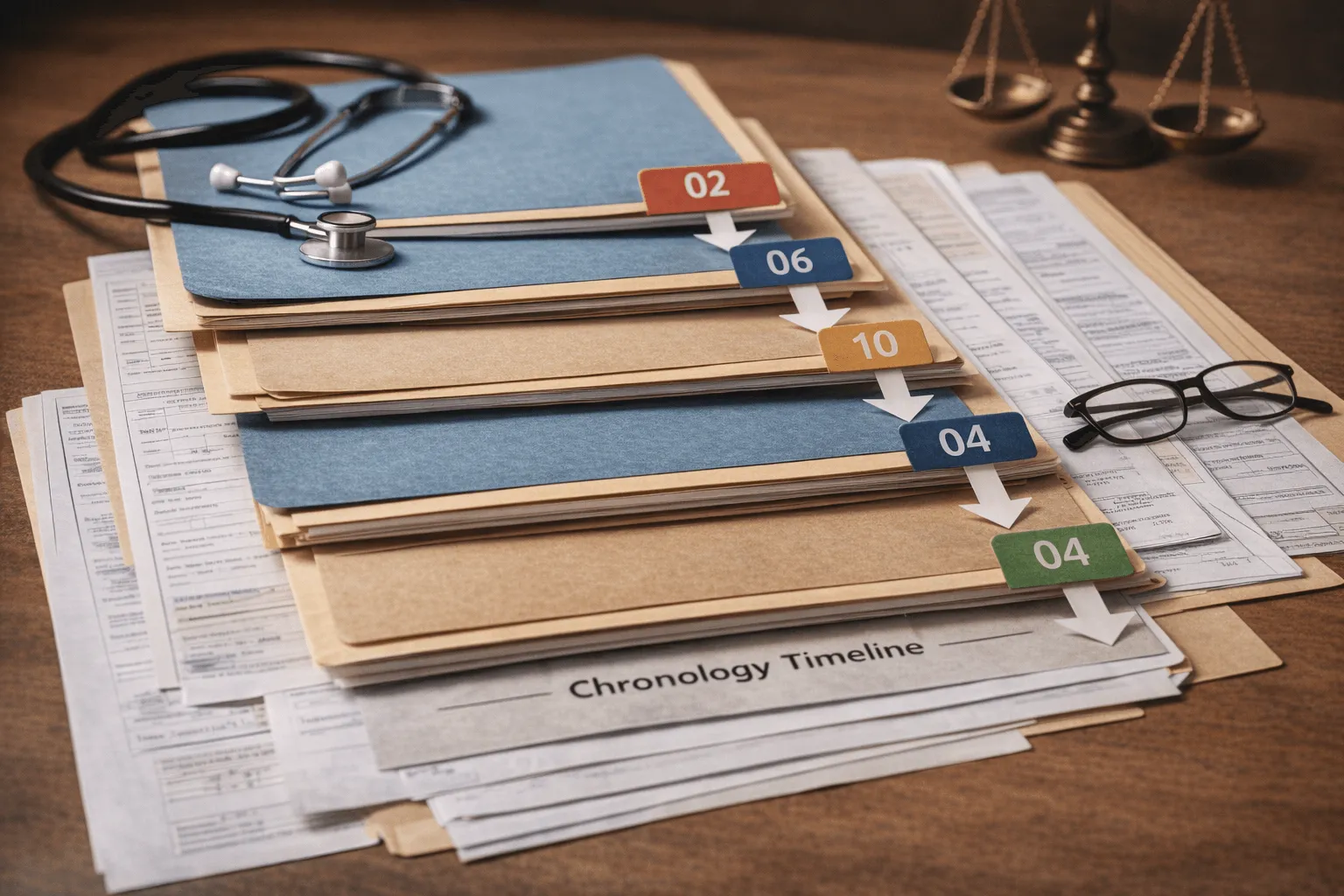
A personal injury medical chronology that lists dates and providers in order is not the same as one that moves a case toward resolution. The difference between the two determines whether a demand package commands serious settlement authority or invites a lowball counter.
This distinction matters because chronology quality functions as a direct lever on case value. Comprehensive documentation reduces information asymmetry in negotiations, while incomplete or poorly structured timelines give defense counsel exploitable gaps. High-volume practices often see the same problem appear downstream when weak chronology structure forces late-stage demand rework.
This article addresses the quality factors that separate persuasive PI chronologies from organizational ones: causation chain documentation, treatment gap handling, pre-existing condition strategy, common failure modes, and where manual workflows lose consistency at scale.
What Is a Personal Injury Medical Chronology?
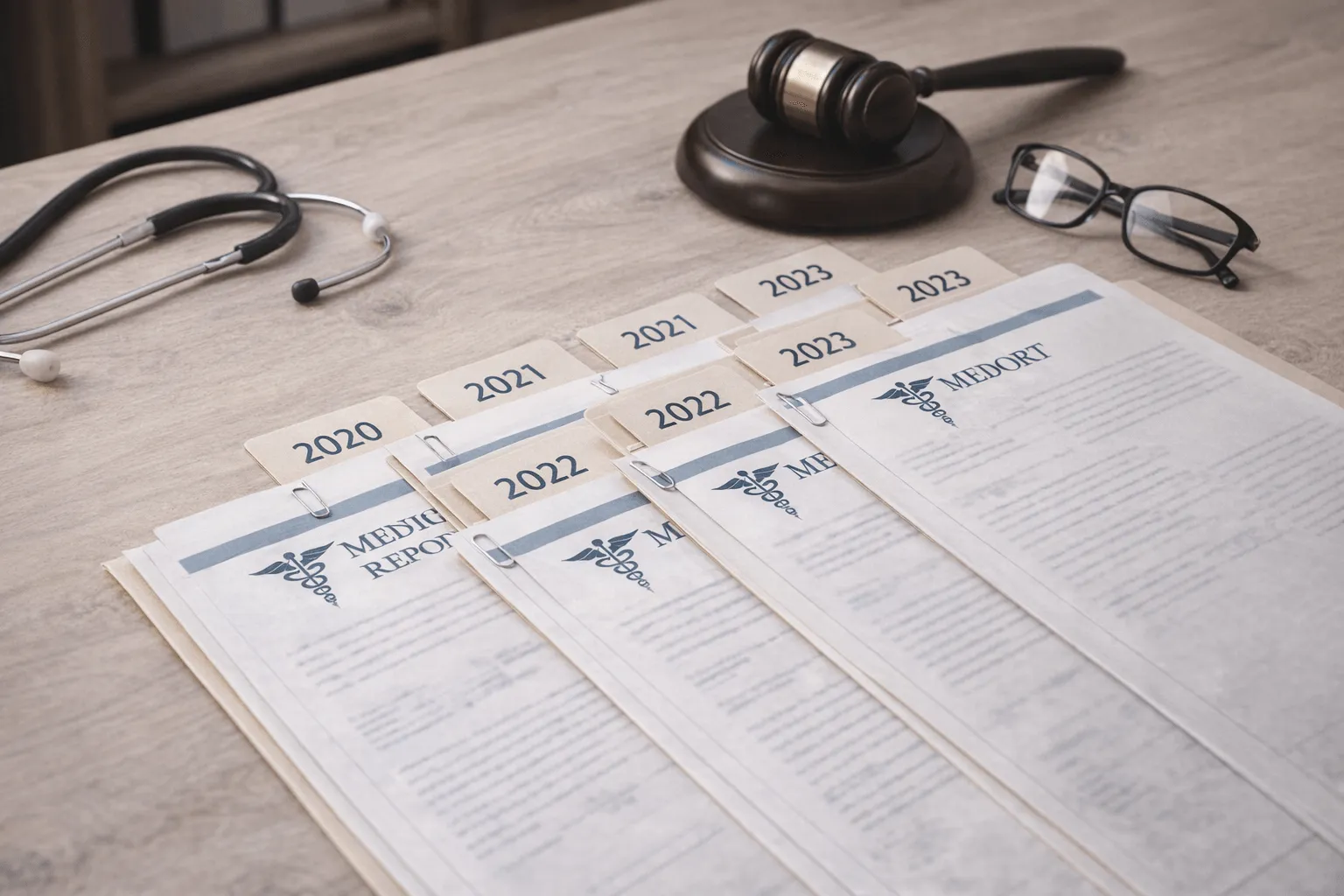
A personal injury medical chronology is a date-ordered, source-cited timeline of every medically relevant event in a claim, from the incident through ongoing treatment. Each entry ties a specific record to a date, provider, and clinical finding so the reader can trace the injury from cause to current status, which is what separates it from a high-level case summary.
How Chronology Quality Drives Settlement Leverage
Chronology quality influences case value through two channels: how it shapes the defense's cost calculation, and whether it gives experts an admissible evidentiary foundation.
The Defense Cost Calculation
The settlement impact of a personal injury medical chronology operates through a specific economic mechanism. Comprehensive evidence presentation reduces uncertainty in damage valuation, pushing settlement offers toward maximum case value and limiting the defense's ability to exploit information gaps in their authority calculations.
This means chronology quality is not an administrative concern; it is a negotiation variable. When defense counsel receives a chronology with clear temporal connections, sourced entries, and documented causation opinions, the projected cost of contesting that evidence at trial rises, which directly influences settlement authority recommendations to carriers.
The scale of documentation risk is not hypothetical. When defense counsel can show that entries are unsourced, altered, or internally inconsistent, the credibility of the entire record erodes. Weak documentation is not a neutral gap; it independently shifts financial exposure.
How Chronologies Meet Evidentiary Standards
Federal court standards reinforce this principle. Under Daubert admissibility requirements, expert testimony must rest on sufficient facts and reliable methodology. The December 2023 amendment to Rule 702 further requires the proponent to show, more likely than not, that each admissibility requirement is met. Medical chronologies that lack clear temporal connections between incident, treatment, and ongoing symptoms fail to provide the factual foundation experts need to form admissible opinions.
A persuasive chronology differs from an organizational one in measurable ways: it facilitates expert opinion formation with sourced, verifiable entries, demonstrates incident-injury-treatment progression that meets evidentiary requirements, and holds up to expert-report admissibility standards even when the immediate purpose is a demand package.
In practice, chronology quality signals preparedness. Adjusters who identify weak documentation recommend aggressive defense postures; those facing comprehensive, well-sourced chronologies recommend higher authority because contesting the evidence costs more than settling.
Causation Chain Documentation for Personal Injury Cases
Personal injury chronology work requires establishing an unbroken sequential link between four elements: incident, injury, treatment, and damages. Plaintiffs must demonstrate both "but for" causation and proximate causation, with medical evidence meeting the "more likely than not" standard.
Medical-legal research identifies five elements essential to proving medical causation:
- Temporal relationship: injury manifestation followed the incident with appropriate timing
- Biological plausibility: injury type consistent with incident mechanism
- Clinical consistency: symptom pattern matches injury pathophysiology
- Diagnostic confirmation: objective findings support clinical presentation
- Exclusion of alternatives: other causes reasonably ruled out
Treating physician causation opinions anchor the plaintiff's case theory, but these opinions require a proper foundation. Trial advocacy standards establish that treating physician opinions are most defensible when the physician documents which specific records informed the opinion, addresses gaps in medical history explicitly, and states the opinion to a reasonable degree of medical probability. The chronology must capture each of these elements with source references.
When a plaintiff sustains multiple injuries, each requires an independently established causation chain, with the substantial factor test applied to each injury and separate healing trajectories tracked on documented timelines.
Causation quality improves materially when chronologies separate what the record states, what the provider assessed, and what the provider opined about cause. A consistent reviewer-ready entry structure prevents inadvertent advocacy language and makes later expert review faster. Every defensible entry should capture:
- Subjective: chief complaint, onset description, and activity limits (quoted or tightly paraphrased)
- Objective: vitals, exam findings, ROM, imaging results, and test metrics
- Assessment/diagnosis: ICD/diagnostic labels and differential notes
- Plan/treatment: medications, PT referrals, injections, restrictions
- Causation language: exact phrasing tying symptoms to the incident (or noting alternative causes)
- Work status: restrictions, disability notes, and return-to-work instructions
Treatment Gap Analysis and Pre-Existing Condition Strategy
Treatment gaps and pre-existing conditions represent the two areas where personal injury medical chronologies most frequently fail to support case theory. Both require proactive documentation strategies rather than reactive explanations.
Documenting Pre-Existing Conditions
The consequences of inadequate handling are severe. In Pellicano v. Nashville (Tennessee Court of Appeals, 2004), the court reversed damages because the treating physician could not state to a reasonable degree of medical certainty that the plaintiff's need for surgery resulted from the second incident rather than a pre-existing herniated disk.
Effective pre-existing condition documentation follows a three-phase architecture that isolates accident-related harm from prior status. Phase one captures the pre-accident baseline: the last visit before the incident, negative findings proving stability, and functional abilities. Phase two documents immediate post-accident change with objective findings that distinguish current status from baseline, a temporal connection to the incident, and direct causation statements. Phase three integrates permanency opinions that separate accident-related aggravation from natural disease progression.
The Michigan Bar Journal notes that adding an issue or analysis dimension alongside pure date order strengthens case analysis. For aggravation claims, organizing entries so each injury's baseline-to-permanency progression reads cleanly spares the reader from extracting a single injury's trajectory from dozens of interleaved entries.
Annotating Treatment Gaps
Treatment gaps require contemporaneous documentary evidence, not retrospective justification. Insurance denial letters, collection notices, provider closure announcements, and scheduling records transform a gap from a liability into a documented barrier to care.
Each gap exceeding three weeks warrants annotation with a specific documented reason and exhibit reference. Under FRCP Rule 56, summary judgment motions require parties to cite specific materials in the record; gaps left unannotated and unsourced become vulnerabilities that opposing counsel can exploit to argue insufficient evidentiary support.
Gap annotations also function as credibility controls. A chronology that merely shows "no treatment for 10 weeks" invites defense arguments about resolution, exaggeration, or intervening cause, while one documenting a gap reason (loss of coverage, delayed specialist availability, surgery authorization pending, documented noncompliance) narrows the argument space. A disciplined approach treats every gap as an evidentiary question with three required fields:
Failure Modes That Weaken PI Chronologies Before Attorney Review
Several recurring quality failures undermine personal injury medical chronologies before they reach the reviewing attorney. These failures operate at the documentation level, where they are difficult to detect without systematic quality protocols.
Common Documentation Failures
Missing provider records represent the most fundamental failure. Cross-referencing medical bills against chronology entries reveals treatment visits with no corresponding clinical documentation.
Appointment schedules also reveal visits that never produced obtained records. Courts routinely impose adverse inference instructions or spoliation sanctions when medical records are lost or destroyed, and in severe cases, FRCP Rule 37(e) authorizes dismissal-level sanctions for failure to preserve electronically stored information.
Inconsistent timelines create credibility problems that defense counsel exploits. NLM research identifies timing inconsistencies, altered records, and contradictory provider notes as documentation flaws that significantly undermine plaintiff positioning. Overlapping or impossible treatment dates and transcription errors involving dates or diagnoses allow defense to characterize the entire medical record as systemically unreliable.
Unsourced entries pose a distinct risk. Every chronology entry must reference the specific source record, date, provider, and record type. Entries that summarize clinical findings without Bates numbers or equivalent identifiers cannot be verified against original documentation.
Additional failure modes include:
- Generic summarization that strips clinically significant detail, losing objective findings that distinguish credible documentation from subjective complaint records
- Failure to reconcile apparent inconsistencies between providers, leaving defense to characterize discrepancies as evidence of malingering
- Omission of negative findings from baseline records that would establish pre-accident stability and support aggravation arguments
- Treating provisional diagnoses as confirmed findings, flattening "rule out" impressions or billing-driven codes into definitive statements that overstate the evidentiary record
These failures compound: missing records create timeline gaps, gaps prevent baseline comparison, and absent baselines undermine aggravation claims. A detailed breakdown of common chronology errors illustrates how these patterns escalate across high-volume caseloads.
Quality Control Checks
Systematic checks catch these failures before a chronology reaches the reviewing attorney. The most effective are simple but applied consistently:
- Three-way reconciliation: bills, records received, and chronology entries
- Source integrity review: Bates range aligns with the cited visit date and provider
- Terminology fidelity: "reports," "denies," "assessment," and "impression" preserved as written
- Contradiction flags: prior similar complaints, conflicting histories, inconsistent laterality, or changes in onset dates
Where Manual Workflows Break Down at Case Volume
Manual personal injury medical chronology workflows face predictable quality degradation as case volume increases. The NALA standards acknowledge that paralegal workload management requires consideration of case complexity, available resources, and supervision requirements, but no professional association publishes standardized capacity thresholds for chronology production.
Volume constraints show up most quickly in the most time-intensive, easiest-to-shortcut parts of production: source verification and cross-referencing between bills, appointment records, and clinical documentation; detailed baseline capture for aggravation claims; and contemporaneous, exhibit-supported gap annotations rather than brief, unsourced notes. Process support, including tech-assisted handling, can address these pressure points without replacing practitioner judgment: reviewing timelines for clinical accuracy, adding causation annotations that require legal judgment, and structuring the final product to support case theory remain the practitioner's role.
Workflow Checkpoints for Consistent Output
A scalable workflow introduces defined checkpoints that occur regardless of case size:
- Intake checkpoint: confirm incident date/time, providers list, and prior injury disclosures are captured as structured data
- Records checkpoint: log received records by provider and date range; reconcile against bills and liens
- Draft checkpoint: enforce citation requirements (Bates, provider, record type) and standard entry schema
- Pre-demand checkpoint: verify gaps are annotated with exhibits; verify baseline and comparative findings for pre-existing conditions
These checkpoints keep chronology quality stable as staffing changes, record volume spikes, or multiple matters approach demand deadlines simultaneously. Firms comparing build-versus-buy options often weigh them against standardized entry formats that keep structure consistent across a caseload.
Case-Resolution Takeaways for Chronology Quality
Chronology quality turns on a small number of repeatable disciplines: a defensible causation chain, exhibit-backed treatment gap explanations, and baseline-to-change documentation for pre-existing conditions. Those disciplines also reduce the defense's ability to reframe uncertainty into a valuation discount.
Tavrn supports medical-chronology teams and broader record analysis workflows by reducing the manual burden that commonly introduces unsourced entries and missing-record blind spots, while preserving attorney and senior-paralegal judgment on case theory and causation framing. Personal injury firm Bigos Law cut case-closing time roughly tenfold after consolidating retrieval, chronology, and demand preparation into one workflow.
To learn more, book a demo.
.png)

.png)
.png)