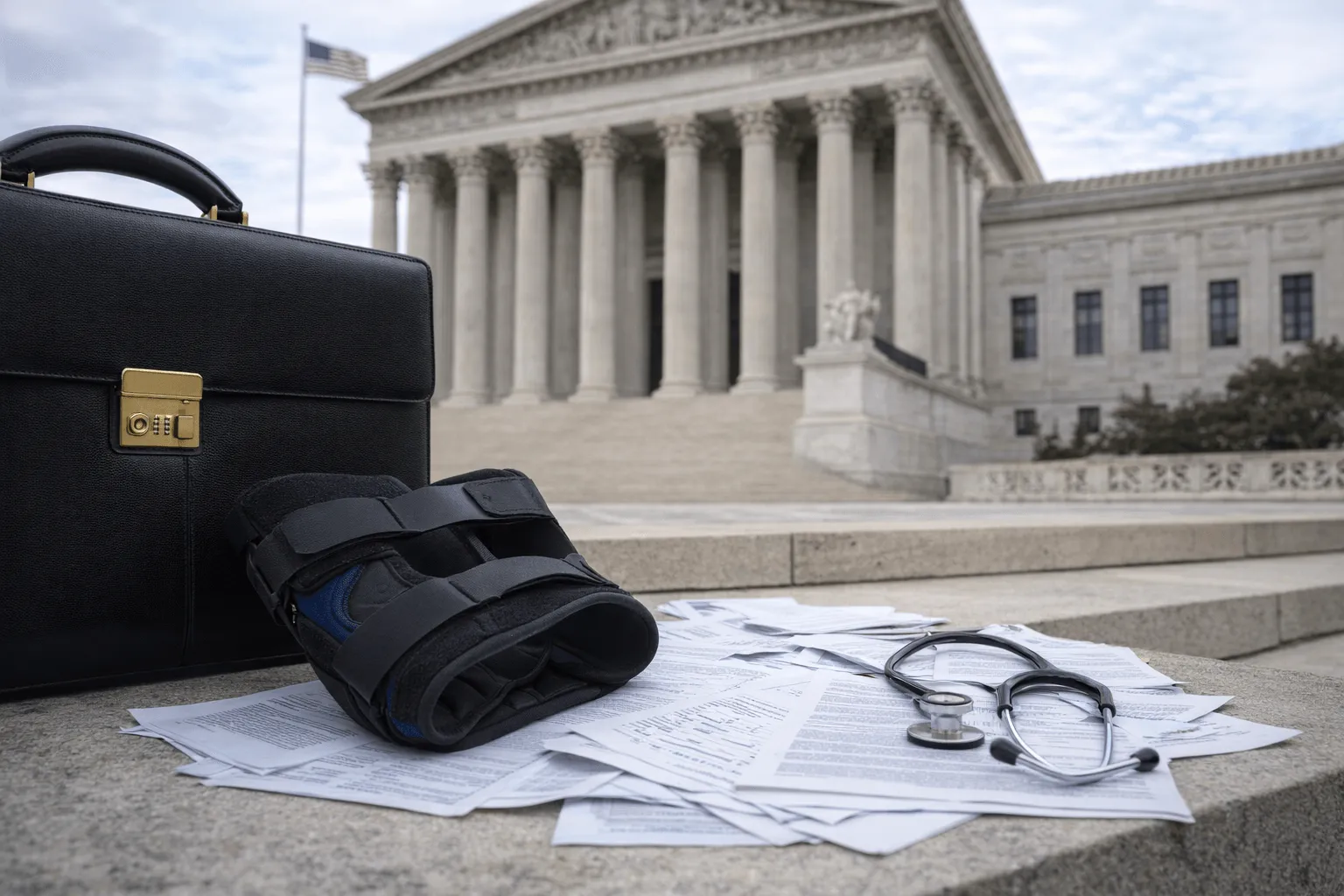
Small personal injury and medical malpractice firms routinely decline viable cases, not because they lack legal talent, but because manual document processing caps how many matters the firm can move at once. Managing partners watching competitors accept the cases their own firms cannot handle recognize the problem is operational, not strategic.
The operational drag often starts upstream, where delays in record intake and organizing provider packets slow everything that follows; medical record retrieval dynamics described in records requests frequently set the pace for case prep. For contingency-fee practices, manual workflows create a hard limit on case volume that traditional hiring cannot solve.
This article examines the bottleneck driving that limit, identifies where AI fits within PI and med mal case preparation workflows, and outlines the compliance and implementation requirements for responsible adoption.
The AI Adoption Landscape for Small Firms
AI adoption among small law firms remains in early stages, though the trajectory is clear. Most use cases start with individual experimentation before firms implement formal structures around policies, training, and oversight.
Organizational adoption among small firms remains limited, with solo practitioners trailing further behind. Individual attorney experimentation runs significantly higher, but informal use rarely translates into firm-level operational improvement.
Small firms tend to adopt AI through individual initiative or small teams rather than firm-wide deployment, relying on CLE seminars for education rather than structured training programs. Medical malpractice practices face additional adoption friction due to HIPAA compliance requirements and heightened sensitivity around patient data protection; NCBI research describes the added ethical and privacy considerations in medical-legal data use.
The Case Capacity Bottleneck in Contingency-Fee Practices
The case capacity problem in small PI and med mal firms is structural, not situational. Manual case preparation work consumes the majority of paralegal time and creates downstream delays that affect every stage of case progression.
The highest-friction work typically includes:
- Medical record review
- Chronology building
- Demand preparation
Senior paralegals managing 25-40 active cases spend 15 or more hours per week reading through medical records and building coherent timelines. That volume leaves little room for the analytical work (identifying treatment gaps, flagging causation issues, spotting inconsistencies) that actually moves cases toward resolution.
The downstream effects compound. Settlement timelines extend when demand packages wait in queue. Attorneys shift from strategy and negotiation to managing preparation backlogs. At intake, viable cases get declined because accepting them would overwhelm existing capacity, a decision that directly reduces firm revenue.
For a managing partner carrying overhead on a contingency-fee model, each declined case represents lost future recovery. The constraint is visible at every level of the firm, but the bottleneck sits in document processing.
Peer-reviewed economic analysis published in the Illinois Law Review documents the financial structure of contingency-fee practice, where several dynamics constrain small firms' ability to scale through hiring:
- Delayed revenue structure forces firms to finance case costs for months or years before any recovery
- Uncertain outcomes mean staffing investments carry financial risk small firms cannot absorb
- Smaller practices lack capital reserves to add paralegals while waiting for contingency payments
- Economic pressure forces selective case acceptance, prioritizing higher-value matters over volume
Research published in the St. Mary's article confirms these contingency-fee constraints directly limit capacity for scaling support staff. The bottleneck cannot be solved by hiring alone, and firms that scale case volume need efficiency gains that do not require proportional increases in fixed costs.
Where AI Fits in PI and Med Mal Workflows
AI applications in personal injury and medical malpractice case preparation are most defensible when they target defined, repeatable document workflows. The operational goal is not full automation; it is reducing the time spent on extraction and organization while maintaining human verification.
AI tends to map most cleanly to three areas:
- Medical record processing
- Chronology building
- Demand letter preparation
AI capabilities in document organization, timeline generation, and information extraction are well-documented across PI and med mal workflows, though no authoritative legal source validates specific vendor-claimed time savings percentages.
Medical Record Processing
AI systems can reduce the manual overhead of sorting and structuring disorganized records, particularly when files arrive in mixed formats from multiple providers. The aim is to surface key treatment facts quickly while preserving the underlying source documents for verification.
Common outputs include:
- Chronological organization of records
- Extraction of structured treatment details
- Flags for high-salience events relevant to damages or liability narratives
Any AI system processing protected health information must meet HIPAA Security Rule safeguard requirements, including executed Business Associate Agreements with AI vendors before processing begins. Full compliance considerations are addressed below.
Chronology Building
AI-assisted chronology building targets one of the most time-intensive paralegal deliverables: converting raw medical records into a usable timeline. This workflow is also well-suited to pilot programs because AI output can be checked line-by-line against the source documents.
The NALA AI guide emphasizes that AI tools in this workflow are assistive, not replacements for paralegal judgment. Paralegals retain full professional responsibility for accuracy verification and quality control.
Effective AI-human collaboration follows a structured sequence: AI generates a preliminary chronology from medical records, the paralegal verifies every entry against source documents, identifies timeline gaps, and validates medical terminology. The attorney then reviews the verified chronology for alignment with case theory.
Quality control tends to be more reliable when the chronology review includes explicit checks. A common approach involves confirming that each entry has:
- A cite to a specific page or Bates range
- The provider name and facility
- Date certainty (exact vs. inferred)
- Separation of subjective complaints from objective findings
Demand Letter Preparation
Demand preparation often combines high-volume arithmetic with narrative synthesis, which makes it a common point of delay in contingency-fee practices. AI can accelerate organization and draft scaffolding, but it cannot replace attorney judgment on valuation, liability, and strategy.
AI can assist with:
- Organizing medical expenses across providers
- Creating structured damages calculations
- Generating initial demand outlines
- Summarizing treatment timelines
For firms that standardize demand packages, AI also supports consistency across cases by creating repeatable structures for special damages tables, treatment summaries, and exhibit references. Demand workflows described in demand letters often break down at the same points: reconciling duplicate bills, identifying treatment gaps that defense will exploit, and ensuring the narrative matches the record.
Analysis published in the SMU law review draws a clear line between AI-appropriate tasks and attorney-required functions. Attorneys retain non-delegable responsibility for:
- Liability evaluation
- Case valuation
- Strategic positioning
- Assessment of non-economic damages
Every AI-generated element in a demand letter requires attorney verification against source documents before submission.
Implementation Approach for Small Firms
Successful AI adoption in small law firms tends to follow a conservative, phased model rather than broad deployment. Small-firm implementations fail most often when tools are introduced without security review, narrow use cases, or measurable success criteria.
Responsible adoption begins with tool selection focused on security protocols, data confidentiality, and client privilege protection before any deployment.
The NCBA guide advocates a problem-first approach, beginning with a single workflow where errors are easily detected and success metrics are clear. A practical implementation sequence:
- Weeks 1-2: Map existing workflows and identify the highest-friction bottleneck
- Weeks 3-4: Select and security-vet an AI tool for that specific workflow
- Weeks 5-8: Deploy with 2-3 users on a single document type
- Weeks 9-12: Evaluate results, refine processes, and decide on expansion
Pilot design benefits from explicit acceptance criteria tied to work product, not only time savings. Common criteria include completeness (no missing providers in the timeline), traceability (entries tied to source pages), and usability (attorney can locate a referenced encounter in under one minute).
Integration over replacement is the operating principle. Efficiency gains in pilot workflows typically emerge over 3-6 months, with clear ROI following consistent use. Initial productivity may decrease during the first weeks as staff adapts.
Measurable metrics should span three categories:
- Efficiency (time saved per task, volume processed per paralegal)
- Quality (error rates, accuracy of AI outputs compared to manual work)
- Financial impact (administrative overhead reduction, case throughput with existing staff)
Staff buy-in determines whether the investment succeeds or fails. The North Carolina Bar Association independently identifies paralegals as the pivotal adoption factor. Strategies that produce results:
- Include paralegals in pilot design from the outset and frame AI as skill augmentation, automating repetitive extraction so paralegals focus on analysis
- Start with the tasks paralegals find most tedious and document time savings early
- Establish paralegal power users who support colleagues through peer learning
If the senior paralegal does not adopt the tool, the investment fails.
Compliance and Oversight Requirements
Regulatory compliance is not an implementation afterthought; it is the foundation AI adoption must be built on. PI and med mal practices typically face overlapping obligations under professional responsibility rules, privacy statutes, and vendor risk-management standards.
Professional Responsibility
ABA Opinion 512, issued July 2024, provides the first comprehensive ethics guidance on attorney AI use. It establishes obligations across competence (Rule 1.1), supervision (Rule 5.3), confidentiality (Rule 1.6), communication (Rule 1.4), and fees (Rule 1.5). Attorneys must understand AI tools before deployment, maintain supervisory responsibility over all AI-generated work product, evaluate how platforms process client data, and ensure billing reflects AI-related efficiencies.
North Carolina Ethics Opinion 2024-1 reinforces that delegation to AI does not eliminate accountability. Attorneys bear professional responsibility for every AI output used in case preparation.
Data Privacy and HIPAA
Law firms handling medical records qualify as business associates under HHS rules, triggering direct HITECH Act liability. AI vendors processing PHI become subcontractors, requiring executed Business Associate Agreements that explicitly address AI model training restrictions, data residency, and breach notification protocols.
Privacy constraints also implicate permitted uses and disclosures under the HIPAA Privacy Rule, which can affect how records are shared across vendors, co-counsel, and experts.
Every firm deploying AI for document processing needs a written AI usage policy covering approved tools, prohibited uses, verification requirements for AI outputs, and designated oversight responsibility.
Operational Capacity as the Adoption Imperative
AI adoption in small PI and med mal firms is primarily an operational capacity decision. Manual document processing creates a hard ceiling on case volume, and contingency-fee economics constrain the ability to hire past that ceiling.
When deployed in narrow, auditable workflows with appropriate safeguards, AI can reduce the extraction and organization burden without shifting professional responsibility away from lawyers and paralegals. Tavrn's AI agents are purpose-built for document workflows that create capacity constraints in PI and med mal practices, including intake-to-summary processes described in record summaries.
.png)

.png)
.png)