Certified EHR adoption is now widespread across non-federal acute care hospitals and office-based physicians, so most provider-produced electronic records pass through EMR/EHR or related health information systems. Paralegals managing a records request confront this variation before a chronology even begins.
An electronic medical record system is a provider-based digital platform that captures and manages patient health information within one provider organization. It holds the clinical and administrative data generated during care at that practice, and that data does not move easily beyond it.
This article explains what EMR systems contain, how they differ from EHRs, why audit trails matter, and how EMR structure affects legal chronology building.
What Does an Electronic Medical Record System Contain?
An EMR system stores the clinical and administrative record of a patient's care at one organization. Much of that information can be mapped to standardized data classes for interoperable exchange, though production exports vary in how consistently they follow those classes. The USCDI is a standardized set of health data classes and constituent data elements maintained by the Office of the National Coordinator for Health Information Technology.
Core EMR data fields reflected in USCDI include the following:
- Demographics: name, date of birth, race, ethnicity, sex, address, and contact information
- Clinical notes: consultation notes, discharge summaries, history and physical, procedure notes, and progress notes
- Problems and diagnoses: recorded conditions with dates of diagnosis and resolution
- Medications: drug, dose, dose units, indication, and fill status
- Laboratory results: test values, specimen type, units, reference range, and interpretation
- Diagnostic imaging: imaging tests and associated reports
- Procedures and vital signs: interventions performed, blood pressure, heart rate, respiratory rate, temperature, height, and weight
- Encounter and billing information: encounter type, location, disposition, and insurance coverage
Provenance metadata links clinical events to author, author role, time stamp, and organization for chronology building. The draft of USCDI Version 6 includes proposed provenance data elements: author, author role, author time stamp, and author organization. When those fields are captured and produced in an export, the time-stamping and provider linkage help a paralegal place clinical events in sequence.
Claims information such as CPT codes and charge amounts falls outside the USCDI data classes, so billing data exists separately in healthcare systems and is often difficult to extract from a standard EMR export.
For legal teams, that separation affects both case valuation and chronology review. A clinical export may show the encounter, diagnosis, medication, lab, or imaging event, while the related charge information may sit in a different billing system or arrive in a different production. Treating an EMR export as the complete provider file can leave gaps between the care narrative and the financial record.
The practical review task starts with identifying which data classes were actually produced. A production that includes progress notes, lab values, and imaging reports but omits provenance fields gives the team clinical content without the same author-and-time linkage. A production that includes encounter information but not billing detail supports chronology development but may not answer charge or CPT-code questions.
What Is the Difference Between an EMR and an EHR?
EMR and EHR are frequently treated as interchangeable, but the distinction carries direct consequences for record retrieval. Organizational scope separates EMRs from EHRs: an EMR stays inside one provider, while an EHR is built to cross organizational boundaries.
The ONC defines an EMR as a digital version of paper charts in the clinician's office where "the information in EMRs doesn't travel easily out of the practice." By contrast, EHRs "are designed to reach out beyond the health organization that originally collects and compiles the information" and contain data from all clinicians involved in a patient's care.
That contained scope is why injury cases generate so many separate requests. A patient who saw an emergency department, an orthopedist, and a physical therapist has three distinct EMRs. Each EMR requires its own formal record request and assembly into the final timeline.
Interoperability in practice remains limited. A Yale study found that only 8% of primary care physicians in 2022 found it very easy to use information from outside organizations using a different EHR vendor, compared to 38% from organizations using the same vendor. The same research reported that 75% of hospitals surveyed acknowledged difficulty exchanging data with organizations on different vendors. No single request produces a complete cross-provider record; the assembly work falls to the legal team.
What Are Audit Trails in an Electronic Medical Record System?
An audit trail is the system-generated log of activity behind the visible record. It captures the user identity behind each interaction along with the date, time, and location of access, and it records the actions that create, change, view, or delete patient information.
These logs typically capture several categories of activity:
- Date, time, and duration of the access event
- The device and physical or network location of access
- Patient and user identification
- The type of action: creation, addition, deletion, change, query, access, copy, print, or copy-and-paste
- The specific data elements accessed and the application used
Federal regulation requires this capability. The HIPAA Security Rule at 45 C.F.R. § 164.312(b) mandates that covered entities implement mechanisms that "record and examine activity in information systems that contain or use electronic protected health information." The standard sets the obligation to capture activity but prescribes no specific content or format. Each entity's risk analysis determines those choices.
Audit trails expose post-incident alterations, backdated entries, and retroactive documentation that the clean face of a printed chart conceals. A printed chart often presents the final version of a note, order, or result. The audit trail can show the activity behind that visible record, including who accessed the record, when the activity occurred, and whether an entry was created, changed, deleted, printed, copied, or viewed.
This distinction matters when the timing of care documentation is disputed. A chronology built only from the face of the chart may place an event at the clinical date shown in the note. Audit-trail data can add a separate activity date, which helps distinguish when the care event occurred from when the record activity occurred.
One caution shapes how paralegals should request these records. Audit trails and metadata generally fall outside the records produced in response to a routine access request. They usually must be requested specifically through formal discovery, such as FRCP 34 requests to parties, FRCP 45 subpoenas to nonparties, or state-law equivalents.
How EMR Structure Affects Legal Case Preparation
The way EMR data is structured and exported determines how much manual work a chronology demands. Across providers, format variation and underlying data quality problems compound that work. A thorough medical record review has to account for both.
Records arrive in heterogeneous formats: scanned PDFs, proprietary EHR exports, HL7 v2 messages, and FHIR bundles. Market fragmentation drives this. 62% of clinician participants in the CMS Promoting Interoperability program reported at least one certified health IT product from Epic Systems Corporation, while a single multi-provider case can still span systems with different export formats and field naming conventions.
Inconsistent data within those exports slows precise sequencing. Research on cross-provider record mapping identified critical inconsistencies such as missing timestamps, missing units of measurement, and inconsistent decimal separators. Each failure disrupts the temporal placement of a clinical event.
Structured, USCDI- and FHIR-compliant data can make extraction more consistent for medical chronologies. In practice, productions can still include scanned pages, proprietary files, standards-based files, and partially structured exports, so human validation remains necessary.
How Legal Teams Evaluate EMR Exports for Chronologies
EMR review for litigation starts with the production received, not the system in the abstract. The same provider-confined record can arrive as a clean PDF, a scanned image set, a proprietary export, a standards-based data file, or a mixture of those formats. Each format changes how the team identifies dates, authors, encounter locations, orders, results, and later amendments.
A defensible chronology depends on separating clinical event dates from system activity dates. Several distinct dates can attach to a single entry, and each answers a different question:
- Encounter date: when the patient was seen
- Procedure date: when an intervention was performed
- Lab collection date: when a specimen was taken
- Result date: when a finding was reported
- Note signature time: when the clinician finalized the entry
- Audit-trail access time: when the record was created, viewed, or modified
When the export includes provenance metadata, the team can connect author, author role, time stamp, and organization to the event being summarized.
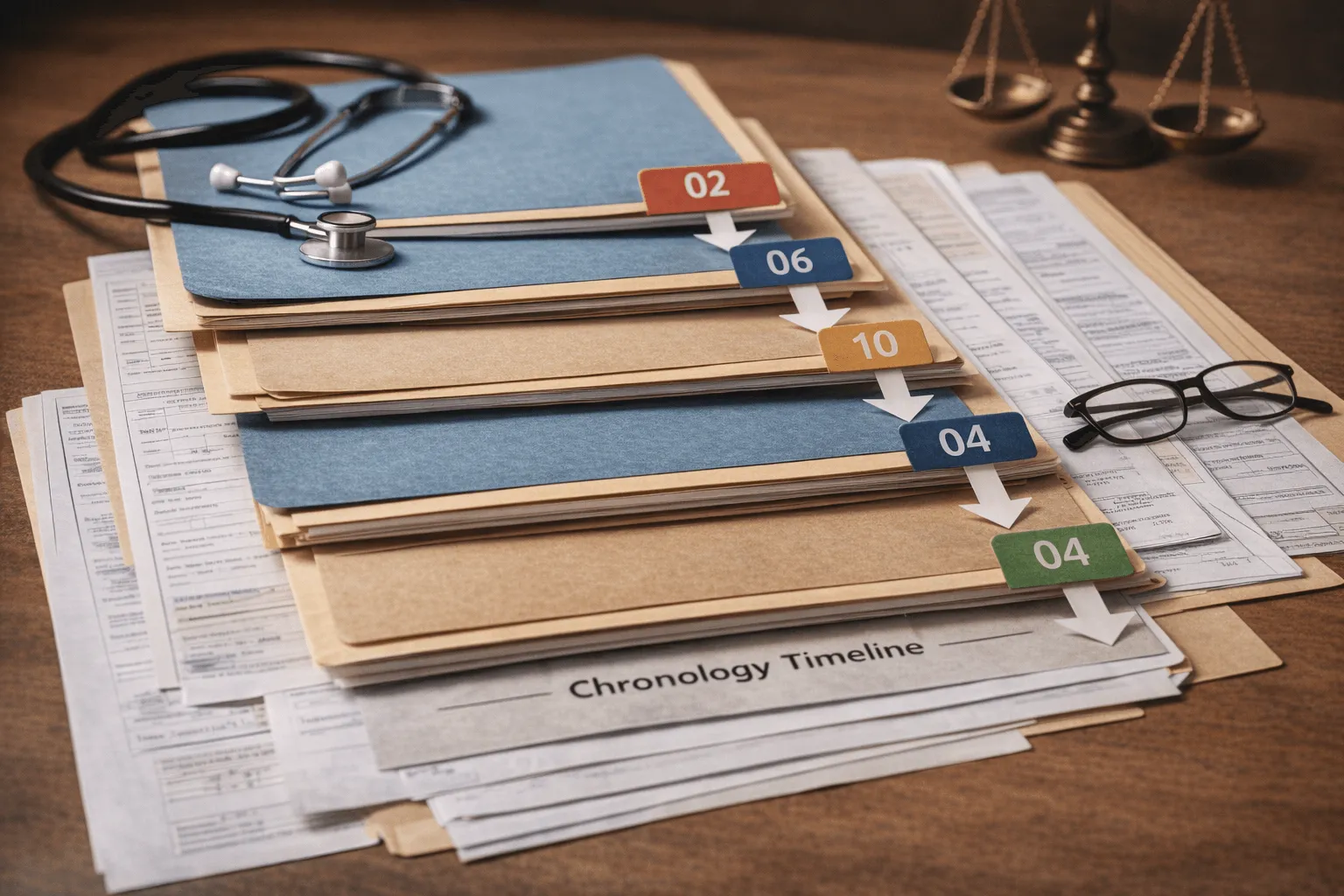
Provider-by-provider reconciliation remains necessary because EMR boundaries rarely match the full treatment story. Emergency department records may establish the initial presentation, specialist records may document diagnosis and treatment planning, and therapy records may show functional progress over time. The chronology becomes reliable only when those separate productions are assembled into one sequence and inconsistencies are flagged for attorney review.
The most time-consuming gaps often come from information that appears partially structured. A lab value may include a result but omit a unit, an imaging report may lack a clear order time, or a note may include a clinical date that differs from its author time stamp. Those problems do not always make the record unusable, but they require a reviewer to avoid overstating precision.
Billing separation creates another review issue. Because claims information such as CPT codes and charge amounts falls outside the USCDI data classes, a standard clinical export may not support damages analysis by itself. Legal teams often have to distinguish the medical chronology, which tracks care events, from the billing record, which supports charge review and economic damages work.
What Separates a Strong EMR Production From a Weak One
The strongest EMR productions give reviewers both the visible clinical record and enough metadata to understand where the entry came from. The weakest productions require more manual cross-checking across notes, encounter summaries, lab reports, imaging reports, billing records, and later-produced audit materials. At high volume that cross-checking becomes the bottleneck, and it is where firms increasingly lean on automation: at Martay Law Office, an Illinois workers' compensation practice handling records that sometimes exceeded 22,000 pages, attorney David Martay describes summarization that was "unbelievable and crazy fast," collapsing what had been a week or more of clerk work. EMR knowledge helps legal teams recognize the difference before relying on a timeline in demand preparation, mediation, or litigation strategy.
Where EMR Knowledge Meets Defensible Case Preparation
An EMR system is a provider-confined digital record holding demographics, notes, diagnoses, medications, labs, imaging, procedures, and vitals, with provenance fields that may identify author, time, role, and organization when captured and produced. Its contained scope forces multi-provider requests, its audit trails expose record alterations when requested through formal discovery, and its format variation across vendors slows chronology work.
Tavrn supports legal teams that need to convert provider-confined records into defensible medical chronologies while preserving the human validation that complex medical records require.