Blog · Law
How to Automate Medical Chronologies for Injury Cases: A Firm Implementation Guide
Medical chronology automation is a workflow change, not software. The readiness, QA, and metrics that make it work.
By Tavrn Team · · 8 min read
Summarise with ChatGPT, Claude or Perplexity
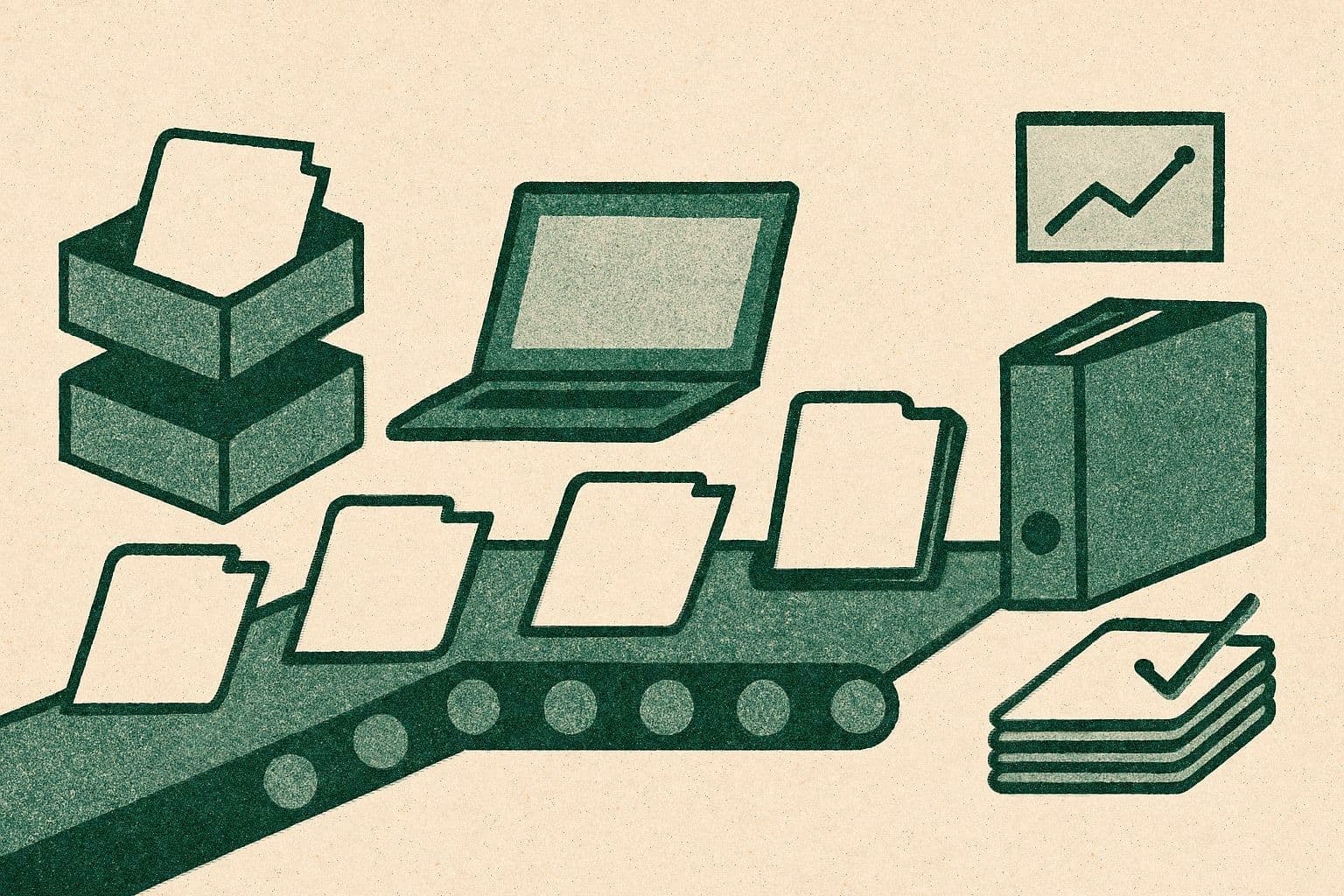
Automating a medical chronology is a workflow decision before it is a software decision. Firms that treat the two as the same end up with a new tool in the stack and the same bottleneck in the case file.
Effective automation depends on what surrounds the software. Records have to arrive complete at intake, a paralegal has to own verification, and the quality check has to fit the way AI fails. Get those right and the chronology moves faster through the file. Get them wrong and automation produces polished errors sooner.
This guide covers the core workflow, the conditions that must be true before automating, how the paralegal role shifts, the quality loop that keeps output defensible, and how to measure whether automation improves case capacity.
The 5-Step Automated Chronology Workflow
Automating a medical chronology means handing the repetitive build to AI and reserving judgment for the people who answer for the work product. The sequence holds across PI and medical malpractice matters.
- Intake and upload: gather the complete record set, confirm scan quality, and organize files by source before processing.
- AI first draft: the system extracts entries, dates and orders them, and hyperlinks each entry to its source page.
- Paralegal verification: a paralegal checks entries against source pages, flags gaps, and corrects misattribution.
- Quality review: a structured check targets the entries with the highest legal consequence before the draft moves up.
- Handoff: the verified chronology feeds demand drafting and expert review without rework.
The order matters more than the platform: weak inputs or thin verification break the chronology regardless of the tool.
What Has to Be True Before Automating a Medical Chronology?
AI cannot compensate for incomplete records. Fragmented provider organization creates attribution problems, and low-quality scans can undermine optical character recognition before review begins. Many firms are not upload-ready, and automation amplifies whatever sits upstream, so inconsistent inputs produce an inconsistent chronology.
Records must be processable in a way that preserves sequence and attribution. A chronology built from disorganized material can look polished while omitting the events that matter most to liability and damages.
Record Completeness Before Processing
In many PI matters, a record set containing only clinical notes will be operationally incomplete. The NALA curriculum identifies acquiring and analyzing police, medical, and employment records as core competencies.
Medical malpractice matters often require a fuller treatment sequence than a limited note set provides. Chronology quality depends on seeing how encounters progressed and how the one event that looks most important at first review fits the larger arc of care.
Completeness also affects downstream issue spotting. Referral notes, imaging, billing material, and provider responses often reveal missing periods of care that thorough record retrieval would surface. They can also identify additional facilities that belong in the chronology but do not appear.
Source-File Quality and OCR Fidelity
Poor scans create predictable chronology defects before review begins. OCR output depends on image quality and page clarity, and typed records process differently than handwritten ones.
Scan quality sets a practical ceiling on OCR reliability, and records scanned at low resolution are less reliable for OCR processing. Handwritten records present a structural problem. Common OCR controls for healthcare records include confidence thresholds with human-reviewer exception routing, medication dictionaries, cross-validation of dates and identifiers, and audit-trail preservation.
OCR problems create chronology-level errors. A visit date may be pulled from the wrong line, a medication name may separate from its dosage, or a provider identifier may be read from a header instead of the note body. These defects carry into verification.
Document Organization and Output Specification
Organization before processing affects output quality after it. If records arrive without consistent naming or clear separation by source, chronology review becomes slower and more error-prone.
Tennessee Bar guidance supports maintaining distinct folders for medical records separate from other case materials. The American Association of Legal Nurse Consultants maintains multiple chronology samples as separate deliverables, so AI output should be compatible with the formats legal nurse consultants and expert reviewers already use.
Teams should specify the chronology output before processing begins. If one team expects a provider-by-provider chronology and another a unified event timeline, review time expands. Staff must rework the draft before they can evaluate substance.
How Paralegal Workflow Changes When AI Builds the First Draft
When a firm automates chronology generation, the paralegal's role shifts from data entry to defensibility review. Firms that try to remove paralegals from this loop trade speed for avoidable reliability problems.
That shift changes staffing pressure in a useful way. The work moves away from manually assembling every entry and toward verifying whether the first draft is complete and properly attributed before attorney review.
Tasks That Move to AI
Several high-volume tasks shift to AI:
- OCR extraction and document ingestion across all pages at once
- Date tagging, provider identification, and chronological ordering
- Source-page hyperlinking for each chronology entry
- Deduplication of records arriving across multiple production batches
- Initial contradiction flagging
- Gap-in-care flagging for treatment intervals beyond defined thresholds
These tasks are pattern-based and prone to attention degradation over large record sets. Moving the repetitive sorting earlier means review starts with a structured draft, not an unprocessed stack.
Tasks That Stay Paralegal-Owned
Verification stays with the paralegal, along with analysis and legal framing. ABA Opinion 512 establishes that competency requirements apply when lawyers use AI, and that responsibility cannot be handed off to a tool.
Paralegal-retained responsibilities include:
- Verification of extracted entries: confirming each entry against its source page.
- Gap analysis and missing-record identification: checking referral notes, billing records, and provider responses for what is absent.
- Treatment gap annotation: explaining intervals with exhibit support.
- Causation linkage: connecting chronology entries to the legal theory of the case.
- Contradiction evaluation: separating legal significance from routine documentation variation.
- Attorney-ready summary framing: flagging the issues that need attorney attention.
Supervision duties under Model Rules 5.1 and 5.3 still extend to AI use by supervised nonlawyers. In practice, that creates two layers of oversight, with the paralegal verifying accuracy and the attorney supervising the result.
This model protects quality under volume pressure. A paralegal can spot when an entry is technically extracted but contextually wrong. The attorney then decides whether the corrected event changes liability framing or damages analysis.
The QA Loop That Keeps AI-Generated Output Defensible
Automation does not remove errors; it changes which ones to watch for. The chronology still has to match the record and support legal use without hidden defects, which is the job of a deliberate quality assurance (QA) loop.
Many chronology errors firms already encounter persist in automated workflows, in different form. A QA pass keeps bad dates and dropped events out of later work product and catches summaries that overstate or misread the record.
Failure Modes Specific to AI-Generated Chronologies
Five failure modes appear most often in automated output:
- Hallucinated or transposed dates: the model ties a date from one section to a clinical event in another.
- Misattributed providers: names pulled from hospital headers do not match the actual note author.
- Duplicated entries from split records: the same encounter appears twice across production batches.
- Dropped entries from low-quality scans: the chronology looks complete but omits events from handwritten or degraded pages.
- Incorrect treatment categorization: a diagnostic impression is logged as a confirmed diagnosis, or a dosage change as a new prescription.
A single chronology error can carry into expert reports, demand drafting, and deposition prep. These failures are serious because they look plausible on first read. A polished entry with a citation and a date can still change the timeline, hide a treatment gap, or overstate a diagnosis.
Structured QA Protocol
A defensible QA process is structured rather than ad hoc. High-risk entries deserve the most attention, and review checkpoints should reflect the legal consequences of a mistake.
- Prioritize high-consequence entries: verify the accident date, diagnosis date, surgery date, and key clinical findings first, confirming each cited source page states exactly what the chronology claims.
- Run dual review with documented checkpoints: the paralegal verifies accuracy and completeness while the attorney determines legal significance and causation. Documented checkpoints counter automation bias.
- Add a separate gap-detection pass: confirm every provider in the records response appears in the chronology, and verify that checkbox-format documents were captured.
- Keep version control: preserve the AI draft and the reviewed final with a redline that shows every correction.
The redline is what makes the work defensible. It shows where the AI draft was wrong and where a person caught it.
Measuring Whether Chronology Automation Delivers ROI
Chronology automation has to move firm performance on queue time, throughput, and demand turnaround. A chronology built faster but still sitting in a queue has limited operational value.
Time saved is a useful starting point; the stronger case comes from what the team did with it. Virginia State Bar guidance states that firms should identify the key metrics for the firm and have a reporting system in place to evaluate ROI over time.
Sample recent cases to baseline performance:
- Cycle time: calendar days from record receipt to chronology completion.
- Labor reallocation: paralegal hours per case on record review versus hours redirected to attorney-facing work.
- Throughput: active cases per paralegal FTE and new cases accepted per month, with capacity-related declinations tracked separately.
- Defect rate: percentage of chronologies needing material correction before attorney use.
- Downstream impact: days from chronology completion to demand submission, and from demand to settlement offer.
Read these together. Faster drafting means little if defect rates climb, and higher throughput means little if the team only shifts cleanup from one role to another.
Where AI Fits in the Broader Case Preparation Workflow
A chronology is one node in a longer case-preparation sequence, sitting between record retrieval upstream and demand drafting or expert review downstream. Automating only the chronology and leaving the handoffs manual keeps many of the same delays.
Manual transfer between stages adds error risk and staff time that offset part of the gain. Output should move into the next stage without reformatting, rechecking page references, or rebuilding summaries. When it cannot, the efficiency gain is only deferred.
The Operational Shift That Makes This Work
Automation that delivers depends on four layers. Input readiness and a redesigned paralegal workflow set up the work. A QA loop calibrated to AI failure modes and measurement tied to throughput keep it honest. Skip one and the others lose their value.
Firms evaluating chronology software should build those layers before selecting a platform. For firms that want chronology automation connected to retrieval and the rest of case preparation, Tavrn builds tools for PI and medical malpractice matters.